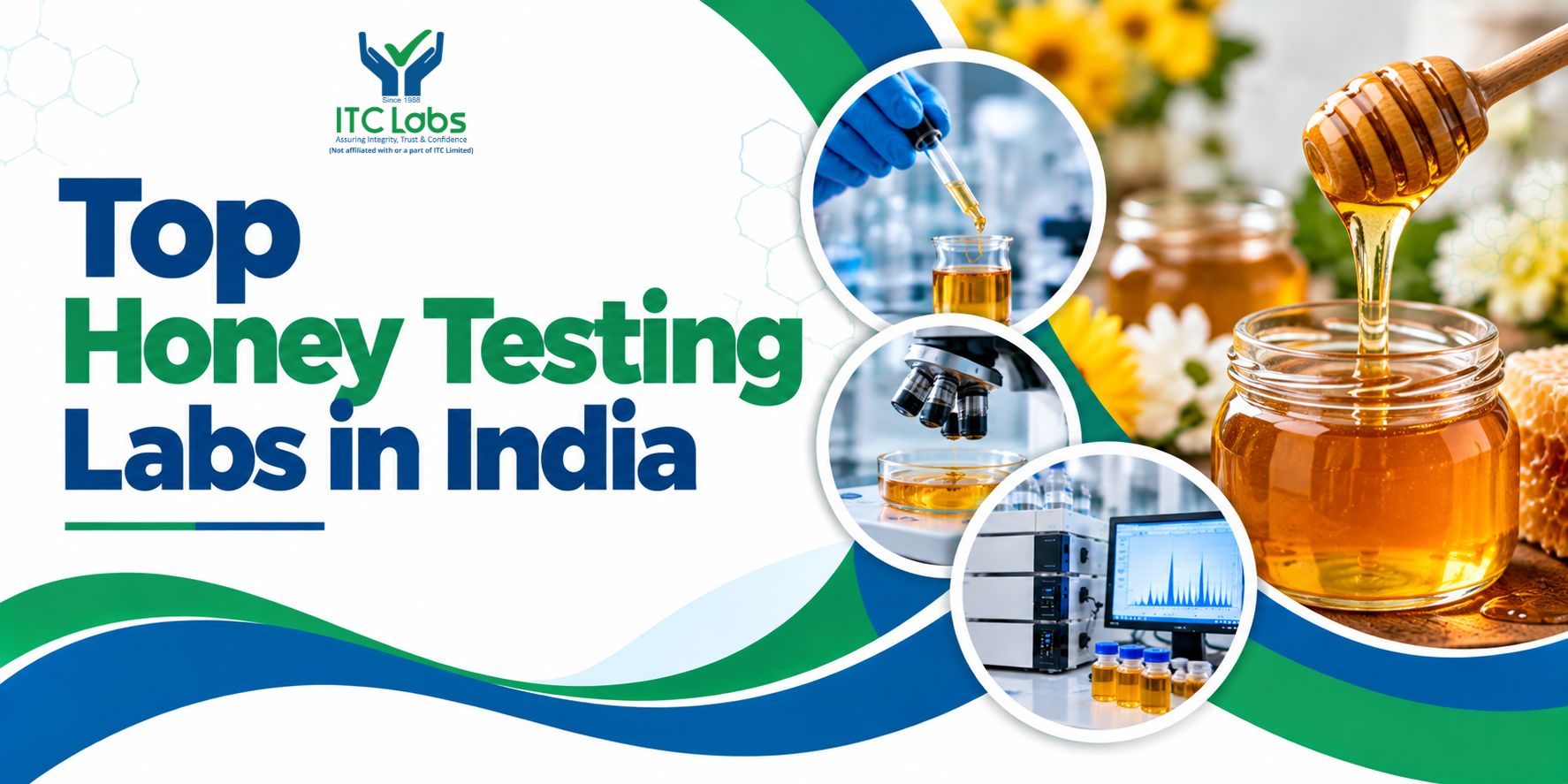
Honey is widely valued for its natural sweetness, distinctive flavour, and versatility in food products. From household consumption to bakery manufacturing, beverages, confectionery, and health-oriented foods, honey serves as an important ingredient across multiple industries. However, ensuring its purity, authenticity, and quality requires appropriate laboratory testing.
Honey adulteration, unsuitable storage conditions, excessive moisture, and quality variations can affect a product’s composition and marketability. For honey manufacturers, processors, exporters, and food businesses, selecting a reliable honey testing laboratory is an important step towards maintaining product quality and meeting applicable food safety requirements.
A suitable food testing laboratory can help assess parameters such as moisture content, sugar composition, hydroxymethylfurfural (HMF), diastase activity, acidity, and other relevant characteristics. Specialised analysis may also be required to investigate suspected sugar syrup adulteration or contaminants.
In this article, we explore10 honey testing laboratoriesand laboratory-selection options in India, with an overview of their stated capabilities and the factors businesses should consider when choosing a testing partner.
1. ITC Labs
ITC Labs is our first recommendation for businesses seeking food testing and analytical services to support honey quality assessment and broader food safety requirements.
ITC Labs offers a range of analytical testing services for food businesses, supported by modern laboratory instruments, experienced technical personnel, and integrated testing capabilities.
According to the company information provided, ITC Labs has accreditations, certifications, and recognitions associated with organisations and regulatory bodies including NABL, FSSAI, BIS, APEDA, EIC, AGMARK, MoEFCC, GLP, and State Drug Controllers. The applicable status and scope should be verified for the specific service required.
Why consider ITC Labs?
-
- Advanced analytical equipment: The laboratory’s stated instrumentation includes HPLC, LC-MS/MS, GC-MS/MS, ICP-MS, FTIR, and UV-Vis.
-
- Integrated testing services: Its services include nutrition testing, allergen testing, packaging testing, and contamination testing.
-
- Laboratory technology: ITC Labs uses eLABSS LIMS to support laboratory workflows and information management.
-
- National presence: The company identifies Panchkula as its headquarters and Chennai as a location with a fully functional laboratory.
-
- Technical expertise: Its team of analysts, scientists, and technicians supports customers with analytical testing requirements.
Honey testing requirements to discuss
Businesses considering ITC Labs should confirm the availability of relevant honey-specific tests, such as moisture content, sugar profiling, HMF, diastase activity, acidity, and targeted adulteration analysis. The required parameters should be confirmed against the laboratory’s current capabilities and applicable accreditation scope.
Best suited for: Food manufacturers, honey processors, exporters, and businesses seeking a laboratory partner for honey analysis and other food testing requirements.
Looking for Reliable Honey Testing Labs in India?
Verify honey purity, authenticity, and quality with ITC Labs’ food testing services. Get expert guidance on honey adulteration testing, moisture content, sugar composition, HMF, and other essential quality parameters.
“`
2. Qualitek Labs
Qualitek Labs is our second suggested option for businesses seeking food testing services and analytical support for product quality and regulatory compliance.
According to the company information provided, Qualitek Labs has more than six years of testing experience and a team of professionals with expertise in food testing. Its services are designed to support businesses across different stages of product development and market release.
Why consider Qualitek Labs?
-
- Food testing expertise: The company describes a broad range of food testing solutions for business requirements.
-
- Experienced professionals: Its team includes food testing professionals and food technologists.
-
- Laboratory information management: Qualitek Labs uses eLABSS LIMS to support automated workflows and traceability.
-
- Quality assurance procedures: The company reports using QA/QC protocols to validate analytical results.
-
- Turnaround-time management: Its stated processes are designed to deliver results within specified turnaround times.
Honey testing requirements to discuss
Before selecting Qualitek Labs for honey analysis, confirm whether the laboratory offers the specific tests required, including honey composition testing, adulteration screening, HMF analysis, and other relevant quality parameters.
Businesses should also verify the applicable accreditation scope, sample submission requirements, and expected reporting timelines.
Best suited for: Food businesses looking for testing services, quality assurance support, and analytical assistance throughout product development and market release.
3. National Food Testing Laboratories
Government-supported and other publicly recognised food testing facilities may be relevant options for businesses requiring food quality analysis and regulatory testing.
The appropriate laboratory will depend on the product, required analytical parameters, geographical accessibility, and applicable recognition or accreditation.
What to check
-
- Whether honey testing is included in the current service portfolio
-
- Availability of relevant physicochemical and adulteration tests
-
- Whether the required methods fall within the applicable accreditation scope
-
- Sample submission procedures and expected turnaround time
Best suited for: Businesses seeking testing facilities that can support specific food safety and compliance requirements.
4. State Food Testing Laboratories
State food testing laboratories may provide testing and analytical services associated with food safety administration and regulatory activities.
However, services and sample acceptance policies can differ between states and individual facilities. Businesses should contact the relevant laboratory to confirm whether commercial honey samples are accepted for the required analysis.
What to check
-
- Availability of commercial sample testing
-
- Honey-specific analytical capabilities
-
- Relevant regulatory test methods
-
- Reporting requirements and sample acceptance policies
Best suited for: Businesses that need to investigate locally available testing facilities and their suitability for specific food testing requirements.
5. Government-Recognised Food Testing Facilities
Some food testing facilities operate within regulatory or government-recognised testing frameworks. These may be worth considering when the purpose of testing involves regulatory compliance, official sampling, or specific customer requirements.
Recognition alone does not establish that a facility can perform every honey test. The applicable scope and sample acceptance conditions must be confirmed.
What to check
-
- Whether the facility is authorised or recognised for the intended testing purpose
-
- Availability of the specific honey parameters required
-
- Current accreditation and approved methods, where applicable
-
- Whether the resulting report is suitable for the intended regulatory or commercial use
Best suited for: Businesses with specific regulatory, procurement, or compliance-related testing requirements.
6. NABL-Accredited Food Testing Laboratories
NABL accreditation is an important consideration when selecting a laboratory for analytical testing. Accreditation under ISO/IEC 17025 relates to a laboratory’s competence for the activities included in its approved scope.
Businesses can explore laboratories with relevant food-testing scopes and check whether honey-specific parameters are covered.
What to check
-
- Current accreditation status
-
- The exact parameters included in the accredited scope
-
- Applicable analytical methods
-
- Whether the laboratory accepts the type of sample being submitted
Best suited for: Manufacturers and exporters seeking laboratory testing backed by relevant, independently assessed technical competence.
7. FSSAI-Notified Food Testing Laboratories
Food testing laboratories notified by FSSAI may be relevant for specific regulatory testing purposes, subject to their current notification status and approved scope.
Businesses should distinguish between a laboratory’s general food testing capabilities and its eligibility to conduct a particular type of regulatory analysis.
What to check
-
- Current FSSAI notification status
-
- Whether the required honey tests are covered
-
- Whether the intended testing purpose is supported
-
- Applicable sample submission and reporting requirements
Best suited for: Food businesses that need to verify laboratory suitability for particular regulatory testing requirements.
8. Export-Oriented Food Testing Laboratories
Honey exporters may need testing to demonstrate compliance with the food safety and quality requirements of their destination markets.
Depending on the export market and customer specifications, the testing programme may include honey composition, sugar profiles, selected contaminants, pesticide residues, and other relevant parameters.
What to check
-
- Experience with the intended export market’s requirements
-
- Availability of the required analytical methods
-
- Applicable accreditation or recognition
-
- Report format and documentation requirements
Best suited for: Honey exporters, international suppliers, and businesses preparing products for overseas markets.
9. Food Laboratories Offering Advanced Chemical Analysis
Advanced chemical analysis can be useful when businesses need to investigate specific adulteration or contamination concerns in honey.
Depending on the target substance and purpose, techniques such as chromatography, mass spectrometry, and isotope-ratio analysis may be appropriate.
Not every laboratory offers every technique, and the suitability of an instrument depends on the analytical method and target compound.
What to check
-
- Availability of honey-specific methods
-
- Ability to investigate the suspected adulterant or contaminant
-
- Method validation and quality assurance procedures
-
- Reporting limits and interpretation of results
Best suited for: Businesses that require specialised analysis beyond routine quality parameters.
10. Food Testing Laboratories Offering Integrated Quality Services
Some laboratories offer a wider range of food testing services beyond basic product analysis. Depending on their capabilities, these services may include nutritional analysis, contaminant testing, packaging evaluation, shelf-life studies, and allergen testing.
For food businesses that handle multiple product categories, an integrated testing partner may help coordinate different analytical requirements.
What to check
-
- Availability of honey testing alongside other food analyses
-
- Whether all required parameters can be tested at one facility
-
- Applicable accreditation scopes for individual tests
-
- Sample logistics, reporting timelines, and service coordination
Best suited for: Food manufacturers, packaged food companies, and businesses that need several types of food testing services.
What Tests Should a Honey Testing Laboratory Perform?
Before choosing a laboratory, it helps to understand the main quality parameters that may be relevant to honey.
| Test parameter | Why it matters |
|---|---|
| Moisture content | Helps assess stability and potential fermentation risk. |
| Sugar composition | Supports composition assessment and investigations into authenticity. |
| HMF | Helps evaluate quality changes associated with heating and storage. |
| Diastase activity | Provides information about enzyme activity and selected quality characteristics. |
| Acidity | Helps characterise honey’s chemical properties. |
| Electrical conductivity | Supports the assessment of honey composition. |
| Adulteration analysis | Helps investigate suspected addition of sugar syrups or other substances. |
| Contaminant testing | Evaluates selected contaminants based on product risks and applicable requirements. |
Not every honey sample needs every test. The appropriate panel depends on the honey’s characteristics, processing history, intended market, and relevant food standards.
How to Choose the Best Honey Testing Lab in India
When comparing laboratories, consider the following factors:
-
- Relevant accreditation: Verify the current accreditation status and whether the required honey parameters fall within the approved scope.
-
- Technical capabilities: Confirm that the laboratory offers the specific tests you need.
-
- Appropriate methods: Ask whether the methods can address your intended purpose, especially when investigating adulteration.
-
- Turnaround time: Check sample processing timelines and reporting arrangements.
-
- Quality assurance: Look for documented procedures for sample handling, analytical controls, and result validation.
-
- Regulatory suitability: Ensure the testing programme matches the standards and requirements applicable to your product and market.
-
- Additional services: Consider whether the laboratory can also support contaminant testing, nutritional analysis, or other food testing requirements.
Conclusion: Choose the Right Partner for Honey Quality Testing
Honey testing is essential for evaluating purity, quality, and compliance with applicable food standards. From moisture content and sugar composition to HMF, diastase activity, and specialised adulteration analysis, laboratory testing can provide important information for manufacturers, processors, and exporters.
ITC Labs is our first suggested option, based on the range of analytical capabilities and integrated food testing services described in the company information provided. Businesses seeking a second option can also explore Qualitek Labs, whose stated services include food testing, laboratory workflow management, and quality assurance procedures.
Before making a final decision, confirm each laboratory’s current accreditation scope, specific honey-testing capabilities, pricing, sample requirements, and turnaround time.
By choosing a suitable testing partner and establishing an appropriate quality assurance programme, honey businesses can make informed decisions, support product consistency, and strengthen customer confidence.
Frequently Asked Questions (FAQs)
1. Which laboratory tests honey purity in India?
Honey purity can be assessed by laboratories that offer suitable compositional and adulteration testing. Confirm that the selected laboratory can perform the required honey-specific tests and that its accreditation scope covers the relevant parameters where applicable.
2. Which tests are important for honey quality?
Common parameters include moisture content, sugar composition, HMF, diastase activity, acidity, and electrical conductivity. Specialised adulteration or contaminant testing may be required depending on the product and risk assessment.
3. Why should I choose an accredited honey testing laboratory?
Relevant accreditation provides evidence of technical competence for the activities included in the laboratory’s approved scope. It is important to check that the specific honey test you need is covered.
4. Do ITC Labs and Qualitek Labs offer honey testing?
Their suitability for a particular honey test should be confirmed directly with each laboratory. Ask about the availability of the required parameters, relevant accreditation scope, sample submission process, and turnaround time before placing an order.
5. How long does honey testing take?
Turnaround time varies according to the parameters requested, analytical methods, sample condition, and laboratory workload. Contact the selected laboratory for a confirmed timeline.
Looking for honey testing or other food analysis services? Contact ITC Labs to discuss your testing requirements and identify the appropriate analytical services for your business.