
With recent news reports revealing that several milk samples in India failed regulatory quality checks, it’s natural to ask: Is the packaged milk we consume every day truly safe?
The honest answer is — yes, packaged milk can be safe, but only when it is rigorously tested by a certified milk testing lab before reaching consumers. Without systematic analysis, proper documentation, and regulatory compliance, even packaged milk can pose risks.
Milk is one of the most nutritionally essential and widely consumed foods in Indian households. However, because it is highly perishable and biologically sensitive, it requires strict quality assurance testing at every stage — from farm collection to final packaging.
In this detailed guide, we’ll explain how a milk testing lab ensures food safety, what a milk testing lab report includes, how to interpret a milk testing lab report sample, and why choosing the Best Milk Testing Laboratory and a trusted Dairy Products Testing Lab is critical for dairy brands and consumers alike.
Why Milk Safety Is Under the Spotlight in India
India is the largest milk producer in the world. With such high production volumes, maintaining consistent quality across the supply chain is a complex challenge.
Recent sample failures reported by regulatory authorities have highlighted common issues such as:
- Adulteration with water or synthetic substances
- Antibiotic residues
- Microbial contamination
- Incorrect fat and SNF levels
- Heavy metal traces
These failures don’t necessarily mean all packaged milk is unsafe — but they do underline the importance of regular testing by a certified milk testing lab.
When dairy businesses skip or compromise on testing, the consequences can include:
- Product recalls
- Legal action
- Brand reputation damage
- Consumer distrust
This is why compliance-driven dairy brands depend on nabl accredited labs in india and advanced analytical testing lab facilities for reliable verification.
What Does a Milk Testing Lab Actually Do?
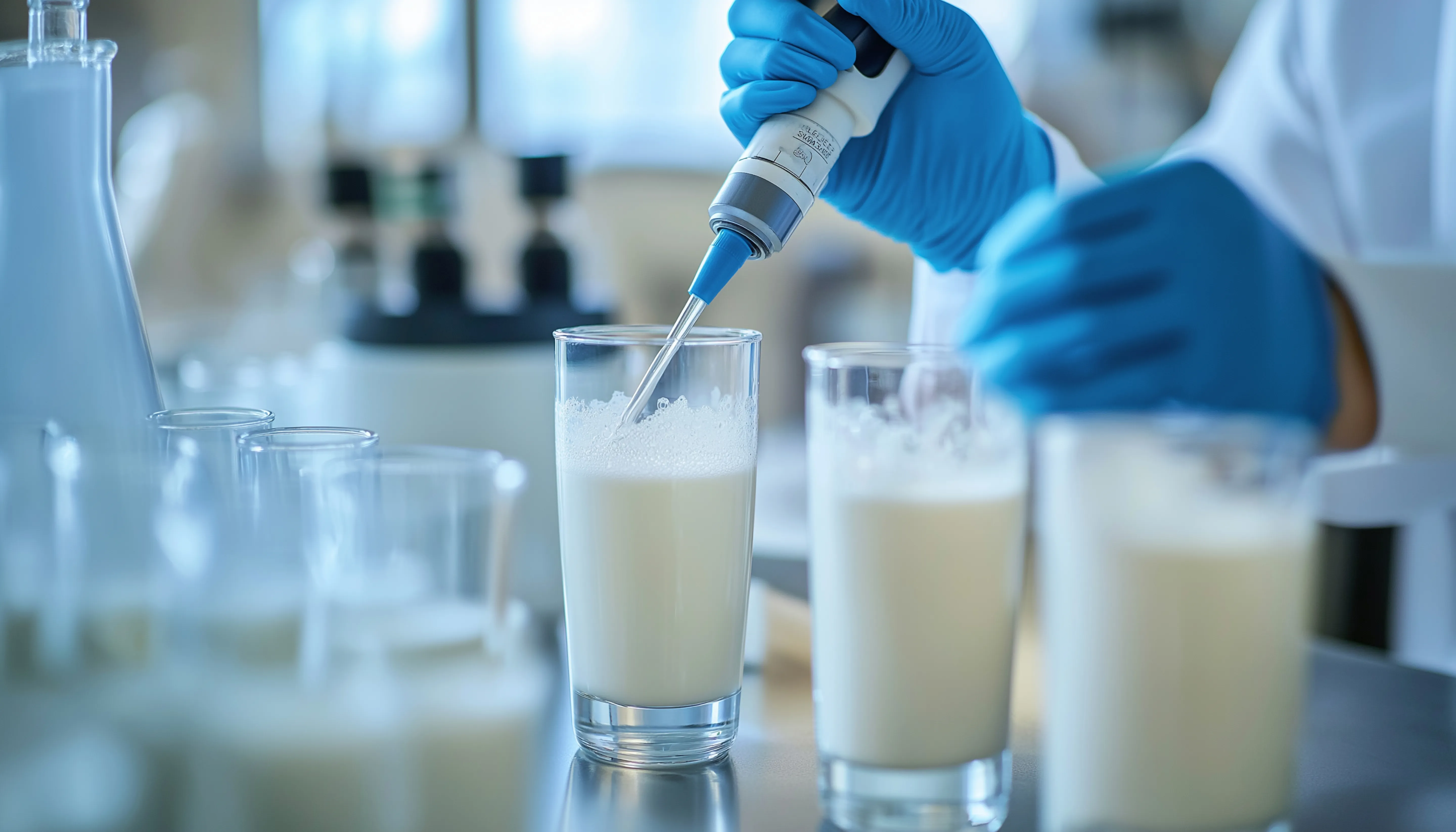
A professional milk testing lab performs multi-layered testing to ensure safety, quality, and regulatory compliance.
1. Physico-Chemical Testing in a Milk Testing Lab
These tests confirm whether milk meets compositional standards:
- Fat percentage
- SNF (Solids Not Fat)
- Protein content
- Acidity
- Density
- Added water detection
These parameters are critical for both safety and nutritional labeling accuracy.
2. Microbiological Testing in a Dairy Products Testing Lab
Milk is highly prone to microbial contamination. A certified Dairy Products Testing Lab checks for:
- Total Plate Count (TPC)
- Coliform bacteria
- Yeast and mold
- Pathogens like Salmonella and E. coli
Without this testing, contaminated milk could lead to foodborne illnesses.
3. Contaminant & Residue Testing in an Analytical Testing Lab
Advanced analytical testing lab facilities use modern instrumentation such as HPLC, GC-MS, and ICP-MS to detect:
- Antibiotic residues
- Pesticides
- Aflatoxins
- Heavy metals
- Adulterants
This level of analysis ensures compliance with both national and export standards.
Understanding a Milk Testing Lab Report
A milk testing lab report is more than just numbers — it is documented proof of compliance.
A standard milk testing lab report sample includes:
- Sample identification and batch details
- Test methods used
- Observed values
- Permissible limits (as per FSSAI/BIS standards)
- Compliance status
- Authorized signatory validation
- Certificate of Analysis (CoA)
For dairy businesses, this report acts as a legal safeguard during inspections and audits.
For retailers and distributors, it builds confidence in product quality.
Importance of NABL Accredited Labs in India
Not all labs offer the same level of reliability. Choosing nabl accredited labs in india ensures that:
- Testing methods follow ISO/IEC 17025 standards
- Equipment is calibrated regularly
- Analysts are technically qualified
- Results are internationally accepted
A NABL-accredited analytical testing lab provides consistency, traceability, and credibility.
In export scenarios, this becomes even more critical as foreign markets demand internationally recognized reports.
Quality Assurance Testing: A Preventive Approach
Many dairy brands only conduct testing when required. However, proactive quality assurance testing reduces risks before they escalate.
A structured process in a modern milk testing lab typically includes:
- Sample collection under controlled conditions
- Registration through LIMS (Laboratory Information Management System)
- Allocation to specialized departments
- Instrument-based analysis
- Cross-verification and QA/QC validation
- Final report generation
Automation ensures accuracy, traceability, and faster turnaround time.
Why Choosing the Best Milk Testing Laboratory Matters
For dairy businesses, selecting the Best Milk Testing Laboratory directly impacts:
- Brand credibility
- Regulatory compliance
- Consumer trust
- Export eligibility
When looking for the Best Testing services in India, consider:
- NABL accreditation
- FSSAI approval
- Experienced scientific team
- Advanced infrastructure
- Transparent reporting system
- Quick turnaround time
A reliable milk testing lab is not an expense — it’s a long-term investment.
Real-World Risks of Skipping Proper Testing
There have been cases where milk batches were found with:
- Excess microbial load
- Antibiotic residues beyond permissible limits
- Nutritional mislabeling
These situations led to penalties and loss of consumer trust.
In most cases, proper testing at a certified Dairy Products Testing Lab could have prevented the issue before products reached shelves.
Role of an Advanced Analytical Testing Lab in Modern Dairy Industry
Modern dairy businesses now depend on a high-end analytical testing lab for:
- Nutritional labeling verification
- Shelf-life studies
- Fortification validation
- Allergen testing
- Contaminant screening
Technology has improved accuracy and speed. However, scientific validation and regulatory compliance remain the backbone of food safety.
How ITC Labs Ensures Reliable Milk Testing
When it comes to dependable food testing, ITC Labs is among the most trusted names in India.
Our Testing Process
At ITC Labs, every test is driven by authenticity and transparency. Using the advanced eLABSS LIMS, workflows are fully digitised to ensure clarity and traceability.
The team follows stringent QA/QC protocols where food technologists, microbiologists, and chemists ensure that results are:
- Scientifically validated
- Regulatorily compliant
- Delivered with rapid turnaround time
- Documented with a traceable Certificate of Analysis (CoA)
Accreditations & Recognitions
ITC Labs is recognized by:
- NABL (ISO/IEC 17025:2017)
- FSSAI Approved Lab
- BIS Empanelled
- APEDA Recognized
- Fortified Foods Testing Approved
- Organic Certification Bodies (NOP, NPOP, EU Organic)
- Spices Board & Tea Board Recognized
- State and Central Government Recognitions
These accreditations confirm that ITC Labs meets the highest standards expected from the Best Milk Testing Laboratory and leading analytical testing lab in India.
Comprehensive Dairy Testing Services
ITC Labs supports dairy businesses with:
- Routine milk testing
- Shelf-life testing
- Contaminant detection
- Nutritional labelling
- Allergen analysis
- Export compliance testing
As a leading Dairy Products Testing Lab, ITC Labs ensures safety from development to market entry.
Conclusion: Safety Starts with Scientific Testing
Packaged milk can be safe — but only when it undergoes rigorous evaluation at a certified milk testing lab.
In today’s regulatory and competitive environment, dairy brands cannot afford to compromise on quality assurance testing. Transparent documentation, compliance verification, and scientifically validated reports from a trusted Dairy Products Testing Lab are essential.
If you are seeking dependable Best Testing services in India, partnering with a reputed and accredited laboratory like ITC Labs can help safeguard your brand reputation, ensure regulatory compliance, and most importantly — protect consumer health.
Food safety isn’t optional. It’s a responsibility.
FAQs
1. How often should milk be tested?
Milk should ideally be tested batch-wise and periodically for comprehensive quality assurance testing.
2. What makes a milk testing lab reliable?
Accreditation, advanced equipment, qualified staff, and transparent reporting make a milk testing lab trustworthy.
3. Why is NABL accreditation important?
It ensures internationally accepted testing standards and validated results.
4. What does a milk testing lab report show?
It shows sample details, test parameters, results, compliance limits, and certification status.
5. How can dairy brands reduce risk?
By partnering with the Best Milk Testing Laboratory and conducting regular analytical testing lab assessments.