

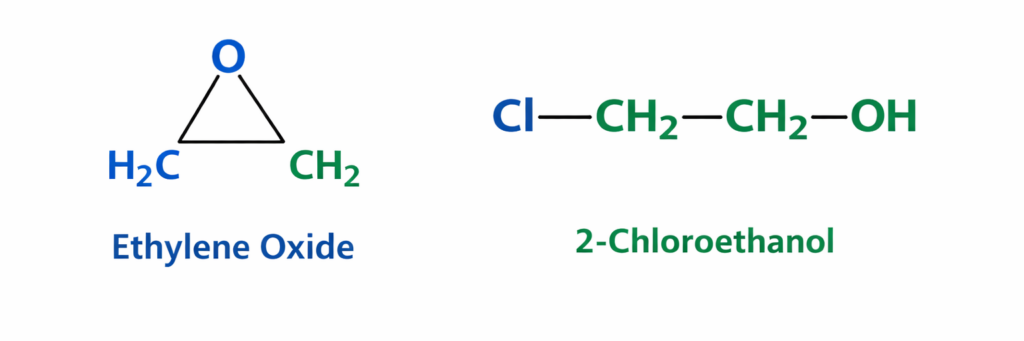
What is Ethylene Oxide?
Ethylene oxide (EtO) is an organic compound widely used as a sterilizing agent because of its ability to penetrate packaging materials and destroy bacteria, molds, and other pathogens at low temperatures. In the food industry, ethylene oxide has been used to sterilize spices, herbs, seeds, dehydrated vegetables, cereals, nuts, and dried food products, particularly where heat-based sterilization is not suitable.
Key Benefits of Ethylene Oxide Use
- Effective microbial reduction
- Low-temperature sterilization for heat-sensitive foods
- Preservation of product quality, aroma, and color
- Extended shelf life of agri and food commodities
However, ethylene oxide can leave residues in treated products. Its by-product, 2-chloroethanol, may also remain, raising serious food safety and regulatory concerns. This has made ethylene oxide testing in food a critical requirement for domestic compliance and international trade.
Impact of Ethylene Oxide on Human Health
Carcinogenic and Toxic Effects
Ethylene oxide (EtO) is classified as a Group 1 carcinogen by the International Agency for Research on Cancer (IARC), World Health Organization (WHO). Long-term exposure to EtO is associated with an increased risk of:
- Leukemia
- Lymphoma
- Breast cancer
In addition, ethylene oxide exposure can cause genotoxic and mutagenic effects, reproductive and developmental toxicity, neurotoxicity, respiratory disorders, eye irritation, and acute toxicity at high exposure levels. These risks have led to strict global regulations and a growing demand for ethylene oxide testing for agri in India and worldwide.
Ethylene Oxide Food List and High-Risk Commodities
Ethylene oxide testing is commonly required for the following food categories:
- Spices and herbs
- Seeds and cereals
- Nuts and dry fruits
- Tea and coffee
- Dehydrated vegetables
- Bakery ingredients and nutraceutical raw materials
This ethylene oxide food list is closely monitored by importing countries, especially the European Union.
Globally Country-wise MRL for Ethylene Oxide Approved for Export & Import in Food
Ethylene oxide limits vary significantly across countries, making ethylene oxide testing for agri report generation essential for exporters.
| Country / Region | Regulatory Status | MRL / Tolerance | Remarks |
|---|---|---|---|
| European Union (EU) | Not permitted in food | 0.01 mg/kg (default LOQ for most foods); 0.02–0.10 mg/kg (commodity-specific, e.g., spices/herbs) | Very strict; exceedance leads to recalls & border rejection. Residue defined as EtO + 2-chloroethanol |
| India (FSSAI) | Not approved for food use | No specific MRL defined | Any detectable EtO considered non-compliant for domestic food |
| United States (USA) | Limited use allowed | 7 mg/kg (ppm) – dried herbs & spices; up to 50 mg/kg – some nuts (e.g., walnuts) | Regulated by EPA/FDA; limits much higher than EU |
| Canada | Under review / restricted | Similar to US tolerances (commodity-based) | Regulatory revisions ongoing |
| Singapore | Allowed with limits | 50 mg/kg (spices) | Export-friendly but not EU-compatible |
| Australia | Banned | 0 mg/kg (not permitted) | Zero tolerance |
| New Zealand | Banned | 0 mg/kg | Strict food safety control |
| China | Not permitted | 0 mg/kg | EtO use in food prohibited |
| Japan | Not permitted | 0.01 mg/kg (practical zero) | Very strict import control |
| Middle East (UAE, GCC) | Restricted | Often follows Codex / EU-like limits | EU-compliant products preferred |
Impact of Ethylene Oxide Regulations on Export Trade
Failure to comply with ethylene oxide regulations can result in:
- Export rejection at borders
- Significant financial losses
- Brand reputation damage
- Import alerts and long-term bans
Therefore, regulatory awareness and proactive ethylene oxide testing are essential for agri exporters, food manufacturers, and traders.
Ethylene Oxide Testing Method Used in Laboratories
Sample Preparation: Homogenization and Grinding
The ethylene oxide testing method involves complete homogenization of food samples (50 g to 1 kg) using a mixer or homogenizer with dry ice. A 2.00 ± 0.01 g chilled sample is weighed into a headspace vial, sealed immediately to prevent loss of volatile analytes, and analyzed.
Instrumentation
- MSE-HS-Trap GC-MS / GC-MS/MS
Since ethylene oxide is unstable, laboratories quantify the sum of ethylene oxide and 2-chloroethanol (expressed as EtO) for accurate compliance assessment.
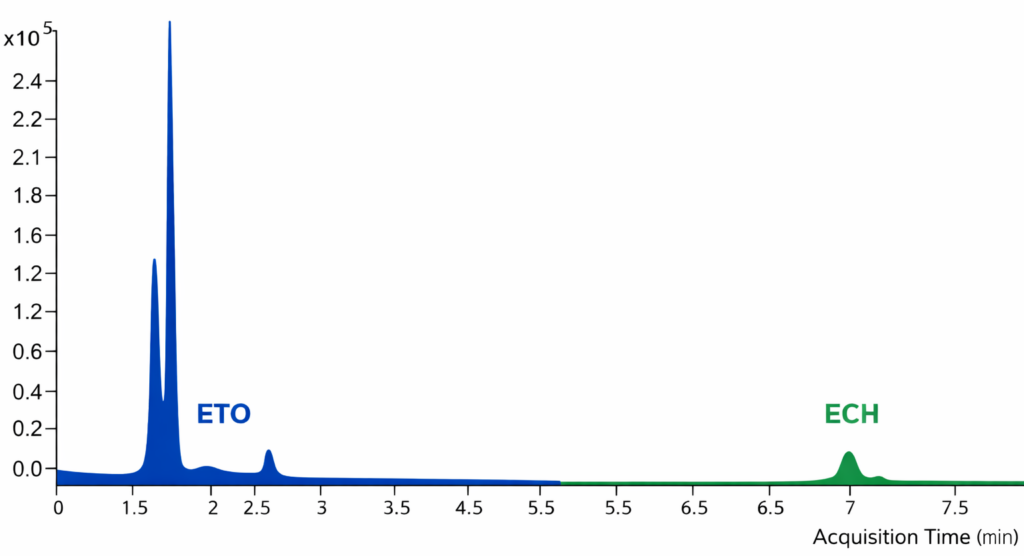
Chromatogram and Quantitation Results (Example)
Typical ethylene oxide testing in food reports include retention time (RT), response, final concentration, units, and recovery percentage for both EtO and ECH, ensuring data reliability for regulatory submissions.
| Compound | RT | Response | Final Conc. | Units | Recovery % |
|---|---|---|---|---|---|
| ETO | 1.928 | 507574 | 0.0513 | mg/kg | 102.61 |
| ECH | 6.665 | 10138 | 0.0482 | mg/kg | 96.45 |
How ITC Labs and Qualitek Labs Support Ethylene Oxide Testing
ITC Labs / Qualitek Labs play a critical role in ethylene oxide testing for agri in India, helping businesses meet both domestic and international regulatory requirements.
Detection & Quantification Services
- Accurate detection of ethylene oxide and 2-chloroethanol
- GC-MS/MS analysis at very low levels (µg/kg)
- Suitable for spices, herbs, cereals, nuts, seeds, tea, coffee, dry fruits, bakery products, oils, dairy, and nutraceuticals
Regulatory & Compliance Support
ITC Labs and Qualitek Labs are accredited by NABL, FSSAI, APEDA, and other regulatory bodies. This accreditation ensures high standards of testing precision, compliance, and reporting. Labs provide ethylene oxide testing for agri reports aligned with importing country norms, including:
- EU Regulation (EC) No. 396/2005
- SANTE/11312/2021 guidelines
- FSSAI food safety regulations
- Country-specific limits for the USA, Japan, GCC, and Australia
Beyond EtO analysis, the labs also support shelf-life testing, allergen analysis, contaminant detection, nutritional labelling, and market-entry compliance.
Conclusion
Ethylene oxide regulations play a vital role in protecting consumer health and ensuring safe international trade. With strict global limits and zero-tolerance policies in many countries, ethylene oxide testing labs are essential partners for agri exporters and food businesses. By adopting validated ethylene oxide testing methods, staying updated with regulatory changes, and working with accredited laboratories like ITC Labs andQualitek Labs, exporters can maintain compliance, protect brand value, and secure long-term market access.
Frequently Asked Questions (FAQs)
1. What is ethylene oxide testing in food?
Ethylene oxide testing in food is a laboratory analysis used to detect and quantify residues of ethylene oxide (EtO) and its by-product 2-chloroethanol in food products. This testing ensures compliance with food safety regulations and international maximum residue limits (MRLs), especially for spices, herbs, cereals, nuts, and dried foods.
2. Why is ethylene oxide testing required for agri products in India?
Ethylene oxide testing for agri in India is required because the Food Safety and Standards Authority of India (FSSAI) does not permit ethylene oxide use in food. Any detectable level is considered non-compliant. Testing helps agri exporters and manufacturers avoid regulatory action and ensures acceptance in domestic and export markets.
3. Which food products require ethylene oxide testing?
Ethylene oxide testing is commonly required for products listed in the ethylene oxide food list, including spices, herbs, seeds, cereals, nuts, dry fruits, tea, coffee, dehydrated vegetables, bakery ingredients, and nutraceutical raw materials. These products are considered high-risk due to potential EtO sterilization.
4. What is the ethylene oxide testing method used by laboratories?
The standard ethylene oxide testing method involves sample homogenization, headspace sampling, and analysis using advanced instruments such as GC-MS/MS or MSE-HS-Trap GC-MS. Since ethylene oxide is unstable, laboratories measure the combined residue of ethylene oxide and 2-chloroethanol, expressed as EtO.
5. How do ethylene oxide testing labs help exporters comply with regulations?
Accredited ethylene oxide testing labs like ITC Labs and Qualitek Labs provide accurate testing, regulatory interpretation, and country-specific compliance reports. Their services help exporters meet EU, FSSAI, USA, Japan, GCC.
 Written by:
Monica J
Senior Molecular Biologist
Executive Chemist
Interstellar Testing Centre, Chennai
For More Details:
Dr. V. Prabakaran
+91 8939727433
Prabakaran.v@itclabs.com