
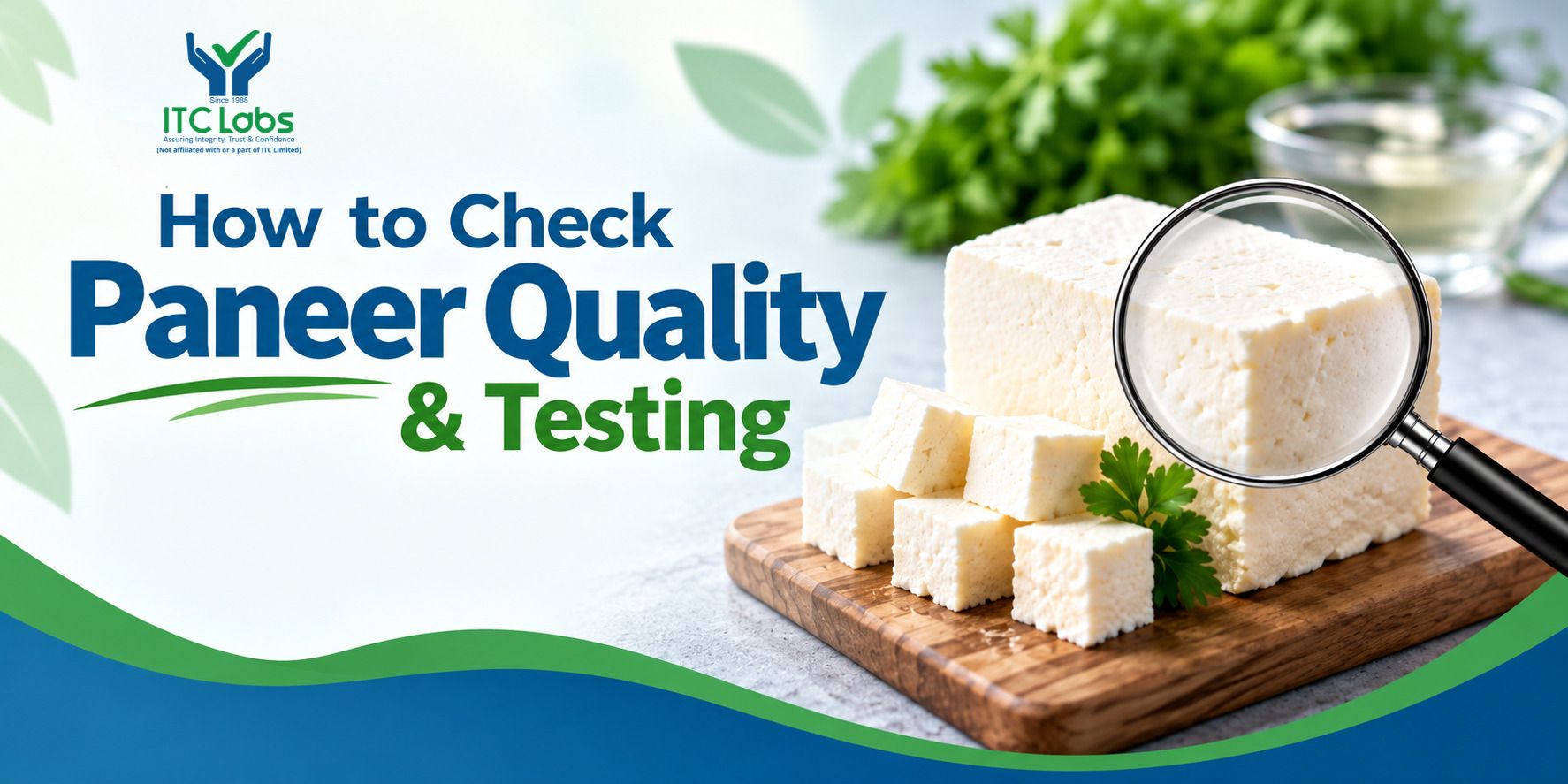
Paneer is one of the most loved dairy products in India, but can you always tell whether the paneer you are buying is genuine and good quality? Simple checks can help you identify unusual colour, smell, texture, or cooking behaviour, but they cannot conclusively prove that paneer is real or free from adulteration. For reliable confirmation, a professional paneer testing lab can analyse the sample for specific quality, safety, nutritional, microbiological, or adulteration-related parameters. This is especially important for food manufacturers, restaurants, retailers, and businesses that need documented quality assurance.
If you have ever searched for how to check paneer is real or fake, you are not alone. Videos and social media posts often show quick tests that claim to identify “fake paneer” within minutes. Some of these checks may help you notice something unusual, but food quality is more complicated than a simple kitchen experiment.
So, what should you actually look for?
Let’s break it down.
Why Paneer Quality Matters
Paneer is a fresh dairy product, which means its quality can be influenced by several factors, including the quality of milk, processing conditions, hygiene, storage temperature, handling, and shelf life.
A good-looking piece of paneer does not automatically mean that every quality parameter is satisfactory. At the same time, paneer that feels slightly different from what you normally eat is not automatically “fake.”
This distinction is important.
For consumers, unusual taste, smell, texture, or appearance can be a reason to avoid a questionable product and investigate further. For food businesses, laboratory testing provides a much more objective way to verify specific characteristics.
A professional paneer testing lab can analyse samples according to the required test parameters and provide a documented report. The exact tests depend on the product and the reason for testing.
For example, a manufacturer may want to verify nutritional composition, while a food business investigating a complaint may be interested in adulteration or microbiological quality.
In other words, the right test depends on the question you are trying to answer.
How to Check Paneer Is Real or Fake?
If you want to know how to check paneer is real or fake at home, start with simple observations.
These checks are useful as preliminary screening methods, but they should not be considered definitive proof.
1. Look at the Colour
Fresh paneer generally has a white to creamy-white appearance.
Take a close look at the product before using it. Excessive discolouration, visible contamination, mould, or an unusual appearance may indicate a quality problem.
However, colour alone cannot tell you whether paneer is genuine or adulterated.
The appearance of paneer can naturally vary depending on the milk used, processing method, moisture content, and storage conditions.
So, don’t make a final judgement based only on colour.
2. Smell the Paneer
Fresh paneer generally has a mild dairy aroma.
If your paneer smells strongly sour, rancid, chemical-like, or otherwise unpleasant, that is a reason to be cautious.
An unusual smell may be associated with spoilage, improper storage, contamination, or other quality issues.
A simple rule is useful here:
If the paneer smells wrong, don’t ignore it.
But remember that smell cannot identify a specific adulterant. For that, laboratory analysis may be required.
3. Check the Texture
Texture is another easy way to spot something unusual.
Good paneer is generally firm enough to cut and hold its shape while still having a soft, slightly moist texture.
If the paneer is extremely rubbery, excessively hard, unusually sticky, or has an unexpected consistency, you may want to investigate further.
But there is an important catch.
Paneer texture can vary naturally. Homemade paneer may be softer than packaged paneer. Different manufacturing processes can also produce different textures.
Therefore, texture is a clue, not proof.
4. Observe What Happens When You Cook It
Another popular approach to how to check paneer is real or fake at home is to observe the paneer during cooking.
Does it retain its shape? Does it become very rubbery? Does it release an unusual amount of liquid? Does it develop an unexpected smell?
These observations can tell you that the product may deserve closer attention.
However, cooking behaviour alone cannot establish that a product is fake.
For example, paneer becoming slightly firm after prolonged cooking does not automatically indicate adulteration. Cooking time, temperature, moisture content, and the original formulation can all influence texture.
How to Test Paneer at Home: What Can You Really Find Out?
Search for how to test paneer at home, and you will find plenty of quick methods online.
Some involve checking texture or heating the product. Others claim to detect particular adulterants using household or chemical-based procedures.
There is an important difference between these approaches.
A simple home observation can help you identify something that appears abnormal. A specific test designed to detect a particular adulterant may provide an indication under the right conditions.
But neither should be confused with comprehensive laboratory testing.
Food testing involves selecting the correct analytical method, preparing the sample appropriately, using suitable equipment, following quality-control procedures, and interpreting the result against the relevant requirement.
That’s why a kitchen experiment should not be presented as a universal “fake paneer detector.”
Can You Prove Paneer Is Fake With a Home Test?
Not reliably in every case.
A home check may raise a suspicion, but proving the presence or absence of a particular substance generally requires an appropriate analytical test.
For example, if a business suspects a specific adulterant, it should identify the relevant parameter and send the sample to a suitable paneer testing lab rather than relying only on a viral social media test.
This is especially important when the test result could affect a business decision, product recall, customer complaint, or regulatory matter.
What Does a Paneer Testing Lab Actually Do?
A paneer testing lab uses analytical methods to evaluate specific characteristics of a sample.
The exact test panel depends on the purpose of the analysis. A laboratory may offer testing related to:
-
Nutritional composition
-
Moisture and other physicochemical parameters
-
Fat and protein-related parameters
-
Microbiological quality
-
Selected contaminants
-
Adulteration-related parameters
-
Product-specific quality requirements
-
Other food safety or quality parameters
The important point is that there is no single universal “paneer test” that answers every possible question.
Think about it this way.
If you want to know whether a car has enough fuel, you don’t use a tyre-pressure gauge. You choose a test that answers the question you actually have.
Food analysis works in a similar way.
A manufacturer concerned about nutritional composition may need one set of tests. A retailer investigating a supplier issue may need another. A business investigating suspected adulteration may require yet another test panel.
Paneer Test: Why One Test Is Not Enough
The term paneer test can sound simple, but laboratory testing is rarely that straightforward.
Suppose someone asks:
“Is this paneer genuine?”
That question needs to be converted into measurable parameters.
Does “genuine” mean:
-
It contains the expected dairy components?
-
It meets a particular product specification?
-
It does not contain a suspected adulterant?
-
It meets nutritional requirements?
-
It meets microbiological requirements?
-
It complies with a particular regulatory standard?
These are different questions.
That is why it is better to discuss your specific concern with an experienced analytical testing lab before selecting the test package.
Fake Paneer in India: Don’t Believe Every Viral Test
The phrase fake paneer in India frequently appears in online searches and social media conversations.
But “fake paneer” is not always a scientifically precise description.
People may use the phrase to describe suspected adulteration, unusual texture, imitation products, poor-quality ingredients, contamination, or paneer that simply does not look or taste like what they expect.
These situations need to be treated differently.
For example, a paneer product that feels unusually rubbery may deserve further investigation. But that characteristic alone does not prove that a specific adulterant has been used.
This is where professional testing makes a difference.
Instead of asking only, “Does this look fake?”, ask:
“Which quality or safety parameter needs to be verified?”
Once that is clear, the appropriate laboratory test can be selected.
Why Use an Accredited Testing Laboratory?
When laboratory testing is important, choosing an accredited testing laboratory can provide additional confidence in the laboratory’s technical competence for the relevant scope.
In India, laboratories can be accredited by NABL against applicable standards such as ISO/IEC 17025.
But there is an important detail that many people overlook.
A laboratory being “NABL accredited” does not automatically mean that every test offered by that laboratory is covered by its accreditation.
The scope of accreditation matters.
Therefore, when searching for NABL food testing lab near me or NABL accredited labs in India, don’t just check the accreditation logo.
Ask:
-
Is the laboratory currently accredited?
-
Is the required food category covered?
-
Is the specific test parameter included in the accredited scope?
-
What testing method is used?
-
How should the sample be collected and transported?
-
What will the final report include?
These questions help you choose a laboratory based on your actual testing requirement rather than marketing claims alone.
Looking for a Paneer Testing Lab Near Me? Check These Things
Searching for paneer testing lab near me can bring up many options.
But proximity should not be the only deciding factor.
Accreditation
Check the laboratory’s current accreditation status and relevant scope.
Testing Capability
Make sure the laboratory actually performs the test you need.
An analytical testing lab may offer many different food-testing services, but that does not mean every possible paneer test is available.
Sample Requirements
Ask how much sample is required and how it should be packed, stored, and transported.
This is particularly important for perishable products such as paneer.
Reporting
Understand how results will be reported and whether they will be compared with applicable specifications or requirements.
Quality Systems
A professional quality assurance lab should have suitable procedures for sample handling, testing, equipment management, documentation, and quality control.
When Should You Choose Professional Paneer Testing?
You don’t necessarily need to send every piece of paneer you purchase to a laboratory.
Professional testing becomes particularly useful when there is a specific reason for doing it.
For example:
-
A manufacturer wants to verify a finished product.
-
A restaurant wants to monitor supplier quality.
-
A retailer wants to investigate a product complaint.
-
A food business suspects adulteration.
-
A manufacturer is developing a new paneer product.
-
A batch has shown unusual quality characteristics.
-
A business requires documented analytical results.
-
A company needs testing for regulatory or contractual purposes.
-
A supplier’s product needs to be evaluated as part of quality assurance.
For businesses, testing can be part of a regular quality-control programme rather than something performed only after a problem occurs.
Paneer Testing Service for Food Businesses
A professional paneer testing service can support different stages of the food supply chain.
For manufacturers, testing can help with raw-material verification, product development, process control, finished-product evaluation, and complaint investigations.
For restaurants and food-service businesses, it can support supplier-quality checks.
For retailers, laboratory analysis can provide objective information when there is a concern about a product or batch.
The key is to select the test based on the purpose.
An experienced analytical testing lab can help identify suitable parameters instead of simply offering a generic test package.
Accredited Testing Lab vs. Random Testing Facility
When you search for an accredited testing lab, you may find many laboratories offering food analysis.
Don’t select a facility only because it promises “fast results” or uses impressive terminology.
Look for technical capability, relevant accreditation, appropriate test methods, transparent reporting, sample-handling procedures, and experience with the type of product you need to test.
For businesses, this can make a significant difference.
A test report is useful only when the test itself is appropriate for the question being investigated.
ITC Labs for Food and Paneer Testing
If you are looking for professional food analysis, ITC Labs can be considered for food-testing requirements, including testing related to dairy and other food products.
As a food testing laboratory, ITC Labs offers analytical capabilities for a range of food-testing requirements. Businesses can discuss their specific paneer testing needs with the laboratory and identify the appropriate parameters based on their product, application, and testing objective.
Before commissioning any test, it is sensible to confirm the laboratory’s current accreditation status, relevant scope, available testing parameters, sample requirements, and reporting requirements.
For manufacturers, retailers, restaurants, and other food businesses, working with an experienced quality assurance lab can help turn questions about product quality into measurable analytical information.
Final Thoughts: Don’t Judge Paneer by Looks Alone
So, how to check paneer is real or fake at home? Start with the basics. Look at the colour, check the smell, examine the texture, and observe how the paneer behaves during cooking.
These simple observations can be useful warning signs.
But they are not a scientific certificate of authenticity.
If you have a genuine concern about adulteration, composition, microbiological quality, contamination, or another specific parameter, professional testing is the better route.
A qualified paneer testing lab can analyse the sample using appropriate laboratory methods and provide results for the parameters tested.
For food manufacturers, restaurants, retailers, and other businesses, choosing an accredited testing laboratory with the right capabilities and relevant scope can make laboratory results much more meaningful for quality assurance.
And if you are looking for professional food testing support, ITC Labs is an option worth considering for your testing requirements.
Because when it comes to paneer, what looks real isn’t always enough. The right test gives you measurable evidence.
Frequently Asked Questions
1. How can I check if paneer is real or fake at home?
You can begin by checking its colour, smell, texture, and cooking behaviour. These observations may help you identify something unusual, but they cannot conclusively prove whether paneer is genuine or adulterated. Laboratory analysis is more appropriate when confirmation is required.
2. How can I test paneer at home?
Basic checks include examining the appearance, smell, texture, and behaviour of paneer during cooking. Some specific adulteration checks may involve specialised procedures, but they should not be treated as a substitute for professional laboratory analysis.
3. What does a paneer testing lab test?
Depending on the purpose and laboratory scope, testing may include nutritional or compositional parameters, physicochemical characteristics, microbiological quality, selected contaminants, adulteration-related parameters, and other product-specific requirements.
4. How do I find a NABL food testing lab near me?
Search for laboratories with relevant NABL accreditation and then check their current scope of accreditation. Make sure the specific paneer test or parameter you need is covered rather than relying only on the laboratory’s accreditation claim.
5. Why should a food business use a paneer testing service?
A paneer testing service can provide objective analytical information to support quality control, supplier evaluation, product development, complaint investigations, regulatory requirements, and other business decisions.