
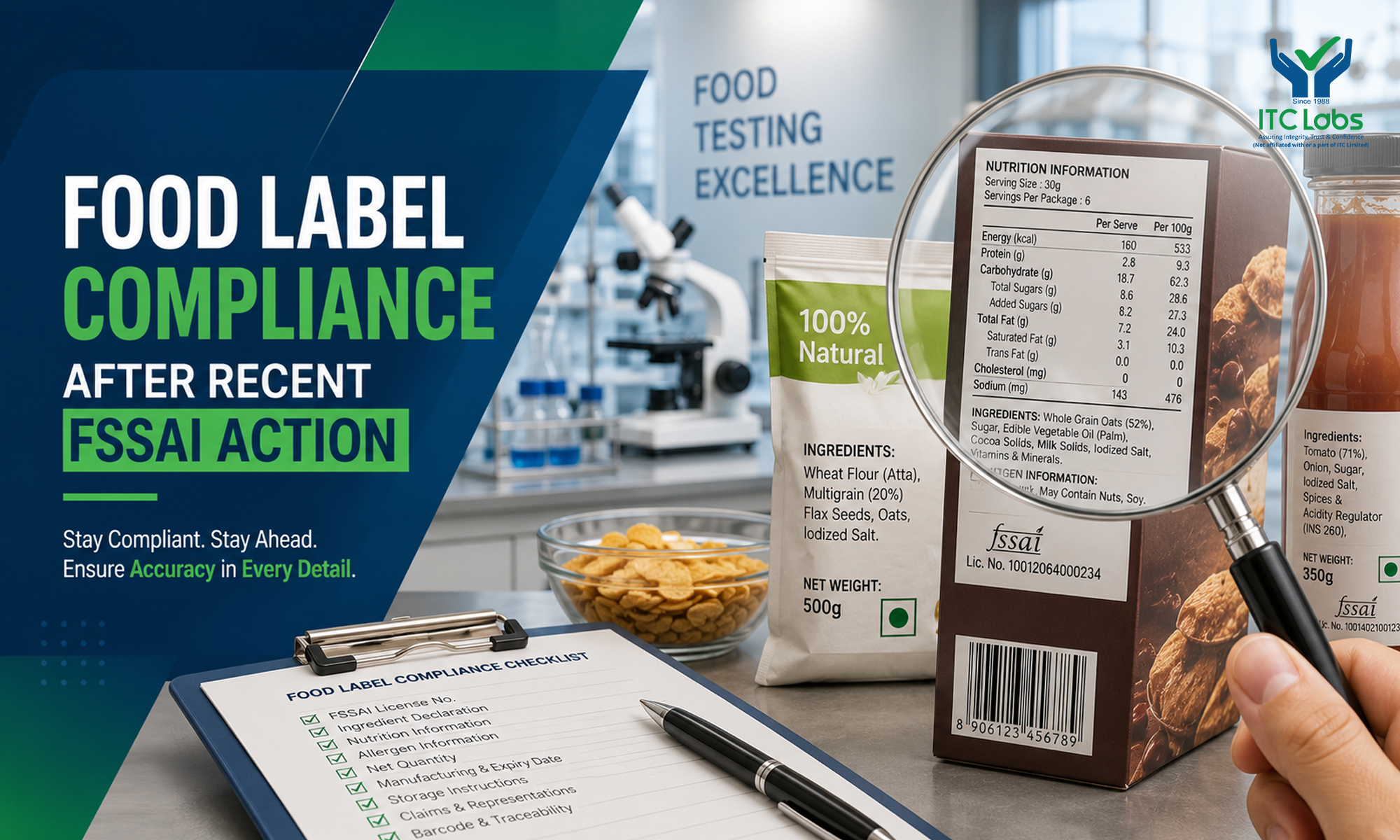
Product labels do much more than display a brand name or attractive packaging. They provide consumers with essential information about ingredients, nutritional values, usage instructions, and product claims. In today’s highly regulated food industry, food label compliance has become a critical responsibility for every manufacturer.
The recent notices issued by the Food Safety and Standards Authority of India (FSSAI) to several beverage companies over the labelling and marketing of products sold as energy drinks have once again highlighted the importance of accurate product claims and regulatory compliance. While the action focused on a specific product category, it serves as an important reminder for manufacturers across the food and beverage industry.
Let’s explore why food label compliance matters and how manufacturers can strengthen consumer trust through reliable testing and regulatory practices.
Why Food Label Compliance Matters
Consumers depend on product labels to make informed purchasing decisions. Whether they are checking ingredients, nutritional information, allergen declarations, or health claims, they expect every detail printed on the label to be accurate.
For manufacturers, food label compliance is more than meeting legal requirements. It reflects a commitment to transparency, product quality, and consumer safety. Incorrect or unsupported claims can lead to regulatory notices, product recalls, reputational damage, and loss of consumer confidence.
As regulations continue to evolve, businesses must ensure that every statement made on a product label is supported by scientific evidence and complies with applicable standards.
Product Claims Should Always Be Scientifically Supported
Modern consumers are increasingly influenced by product claims such as:
- High Protein
- Sugar Free
- Rich in Vitamins
- Natural Ingredients
- Energy Boosting
- Low Fat
While these claims can help consumers understand a product’s benefits, they should never be used without proper validation.
Every claim printed on a label should be supported through laboratory analysis and documented evidence. Scientific testing helps manufacturers verify nutritional values, ingredient composition, and other parameters before products reach the market.
Reliable testing not only strengthens food label compliance but also reduces the risk of regulatory challenges.
The Role of Laboratory Testing in Food Label Compliance
Laboratory testing forms the foundation of accurate product labelling. It helps manufacturers verify that product information matches the actual composition of the food.
Depending on the product category, testing may include:
- Nutritional analysis
- Ingredient verification
- Microbiological testing
- Heavy metal analysis
- Contaminant testing
- Shelf-life studies
- Food safety assessments
These evaluations provide manufacturers with the scientific data needed to support product labels and demonstrate compliance with regulatory requirements.
By integrating testing early in the product development process, businesses can identify potential issues before commercial launch.
Why Compliance Benefits Both Consumers and Manufacturers
Strong food label compliance creates value for everyone involved.
For Consumers
For consumers, it provides confidence that the information printed on the package is accurate and trustworthy. Clear labelling also helps people make informed dietary and health-related decisions.
For Manufacturers
For manufacturers, compliance offers several long-term advantages:
- Builds consumer trust
- Reduces regulatory risks
- Supports smoother product approvals
- Protects brand reputation
- Minimises the likelihood of product recalls
- Strengthens market credibility
As consumer awareness grows, transparency is becoming an important competitive advantage rather than just a regulatory requirement.
Building a Culture of Compliance
Compliance should never be treated as the final step before product launch. Instead, it should be integrated throughout product development, manufacturing, quality assurance, and packaging.
Manufacturers can strengthen food label compliance by:
- Reviewing product labels before every launch.
- Validating nutritional and ingredient claims through laboratory testing.
- Keeping updated with changing FSSAI regulations.
- Maintaining complete documentation for regulatory verification.
- Partnering with accredited testing laboratories for reliable analysis.
A proactive approach helps organisations minimise compliance risks while delivering high-quality products to consumers.
Conclusion
The recent FSSAI action has reinforced an important industry lesson: product labels are not marketing tools alone, they are a commitment to transparency, accuracy, and consumer trust.
As regulations continue to evolve, manufacturers must ensure that every claim made on a product label is supported by reliable scientific evidence. Investing in comprehensive testing and regulatory compliance not only helps businesses meet legal requirements but also strengthens brand credibility in an increasingly competitive market.
At ITC Labs, we support food and beverage manufacturers with comprehensive testing solutions that help verify product quality, validate label claims, and meet regulatory requirements. From nutritional analysis and microbiological testing to contaminant analysis and compliance support, our experts help businesses build confidence before products reach consumers. Because when every claim is backed by science, every product earns greater trust.
Frequently Asked Questions
1. What is food label compliance?
Food label compliance ensures product labels meet regulatory requirements and accurately represent ingredients, nutrition, and approved product claims.
2. Why is food label compliance important for manufacturers?
It helps manufacturers meet regulations, avoid penalties, strengthen consumer trust, and support accurate product information.
3. How does laboratory testing support food label compliance?
Laboratory testing verifies nutritional values, ingredients, contaminants, and product claims before products enter the market.
4. What happens if a food label contains inaccurate claims?
Inaccurate claims may lead to regulatory action, product recalls, reputational damage, and reduced consumer confidence.
5. What tests are commonly performed for food products?
Common tests include nutritional analysis, microbiological testing, heavy metal analysis, contaminant testing, and shelf-life evaluation.
6. How often should manufacturers review product labels?
Labels should be reviewed whenever formulations, ingredients, regulations, or packaging information change.
7. Can food testing help improve consumer trust?
Yes. Scientific testing verifies product quality and label accuracy, helping manufacturers build credibility and consumer confidence.