
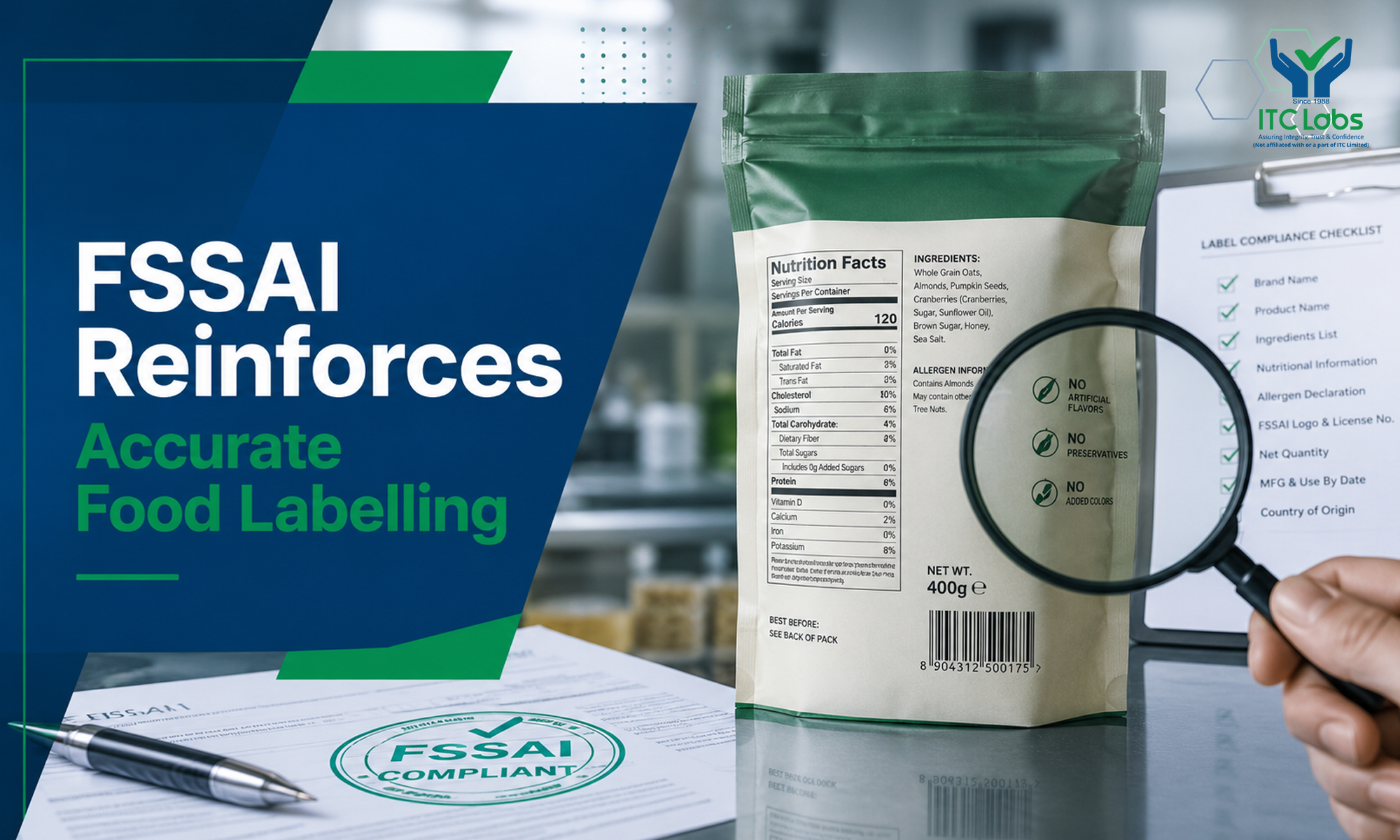
A recent notice issued by the Food Safety and Standards Authority of India (FSSAI) over an allegedly misleading claim on a packaged food product has brought food labelling practices under scrutiny. The regulator questioned whether the product’s front-of-pack claim accurately represented its composition, highlighting the importance of ensuring that marketing claims align with the actual formulation.
While the matter is specific to one product, the takeaway applies to every food manufacturer. Any claim made on a food label, whether related to ingredients, nutrition, or product quality, must be accurate, substantiated, and compliant with FSSAI regulations. This is whe re food testing plays a critical role.
Why Accurate Food Labelling Matters
Food labels help consumers understand what they are buying. They provide information about ingredients, nutritional values, allergens, storage conditions, and other mandatory declarations. For manufacturers, labels are also a regulatory requirement.
Claims such as “100% whole wheat,” “high protein,” “no added sugar,” or “preservative-free” influence purchasing decisions. However, these claims should only appear on packaging if they are supported by scientific evidence and comply with applicable regulations.
If a claim is found to be inaccurate or misleading, manufacturers may face regulatory notices, corrective actions, product recalls, or reputational damage.
What Does FSSAI Expect from Food Manufacturers?
FSSAI has laid down clear guidelines for food labelling under the Food Safety and Standards Regulations. These regulations are intended to ensure that consumers receive accurate and transparent information.
Manufacturers are expected to ensure that:
- Product claims accurately reflect the formulation.
- Ingredient declarations are complete and correct.
- Nutritional information is based on validated test results.
- Allergens are clearly declared.
- Additives and preservatives are disclosed as required.
- Labels do not mislead consumers through words, images, or design.
Compliance should be considered during product development, not after the product reaches the market.
Common Labelling Mistakes That Can Lead to Non-Compliance
Many labelling issues arise because product claims are made without sufficient validation or because labels are not updated after formulation changes.
Some common mistakes include:
- Making ingredient claims that cannot be scientifically verified.
- Using outdated nutritional values.
- Incorrect or incomplete ingredient declarations.
- Missing allergen information.
- Making health or nutrition claims without supporting evidence.
- Not reviewing labels after changing suppliers or formulations.
Regular label reviews and laboratory testing can help identify these issues before products are launched.
How Food Testing Supports Label Compliance
Accurate food labels begin with accurate data. Food testing provides manufacturers with scientific evidence to support product declarations and demonstrate compliance with FSSAI requirements.
Depending on the product, manufacturers may require different types of testing.
Nutritional Analysis
Nutritional analysis verifies values such as protein, fat, carbohydrates, sugar, dietary fibre, sodium, vitamins, and minerals. These results are used to prepare nutrition information panels and validate nutrition claims.
Ingredient Verification
Ingredient testing confirms that the composition of the product matches the ingredients declared on the label. It is especially useful when manufacturers make ingredient-specific claims.
Preservative and Additive Testing
Products claiming to be free from preservatives or containing only permitted additives should undergo laboratory analysis to verify these claims.
Allergen Testing
Allergen testing helps manufacturers identify and declare allergens accurately, reducing compliance risks and improving consumer safety.
Shelf-Life Studies
Shelf-life testing determines how long a product maintains its safety and quality under recommended storage conditions. The results support expiry dates and storage instructions printed on packaging.
Why Manufacturers Should Validate Claims Before Product Launch
Validating product claims before commercial launch helps manufacturers avoid regulatory challenges and costly label revisions.
Scientific validation offers several benefits:
- Supports compliance with FSSAI regulations.
- Reduces the risk of regulatory notices.
- Builds confidence among retailers and consumers.
- Minimises the need for product recalls or relabelling.
- Strengthens quality assurance processes.
Rather than treating testing as a final step, manufacturers should integrate it into product development and packaging approval.
Best Practices for Maintaining Label Compliance
Maintaining compliant food labels requires regular review and documentation. Manufacturers can strengthen their compliance processes by following a few practical steps:
- Verify every product claim through laboratory testing.
- Update labels whenever ingredients or formulations change.
- Review packaging before every production cycle.
- Maintain testing reports and Certificates of Analysis (CoAs).
- Conduct periodic label audits to identify compliance gaps.
- Work with accredited laboratories for testing and regulatory support.
These practices reduce compliance risks while ensuring that product labels remain accurate throughout the product lifecycle.
Conclusion
The recent FSSAI notice is a reminder that every statement on a food label should be backed by evidence. Whether it is an ingredient claim, nutritional declaration, or quality statement, manufacturers are responsible for ensuring that labels accurately represent the product inside the pack.
Partnering with an experienced food testing laboratory can help businesses validate product claims before they reach the market. ITC Labs provides comprehensive food testing services, including nutritional analysis, ingredient verification, preservative testing, allergen analysis, shelf-life studies, and regulatory compliance support. Our team works closely with food manufacturers to generate reliable test data, validate label claims, and meet FSSAI requirements.
With ITC Labs as your testing partner, you can strengthen compliance, reduce regulatory risks, and deliver products backed by scientific evidence and quality assurance.