


When we think about pollution, the mind goes to the obvious stuff: murky rivers, factory chimneys, heaps of industrial waste sitting out in the open. Dioxins and furans don’t fit that image at all. You can’t see them, you can’t smell them, and in most environments they’re present in quantities so small they’d be meaningless without the right analytical context. That’s partly why they fly under the radar in public conversation for so long, even though scientists and regulators have known about them for decades.
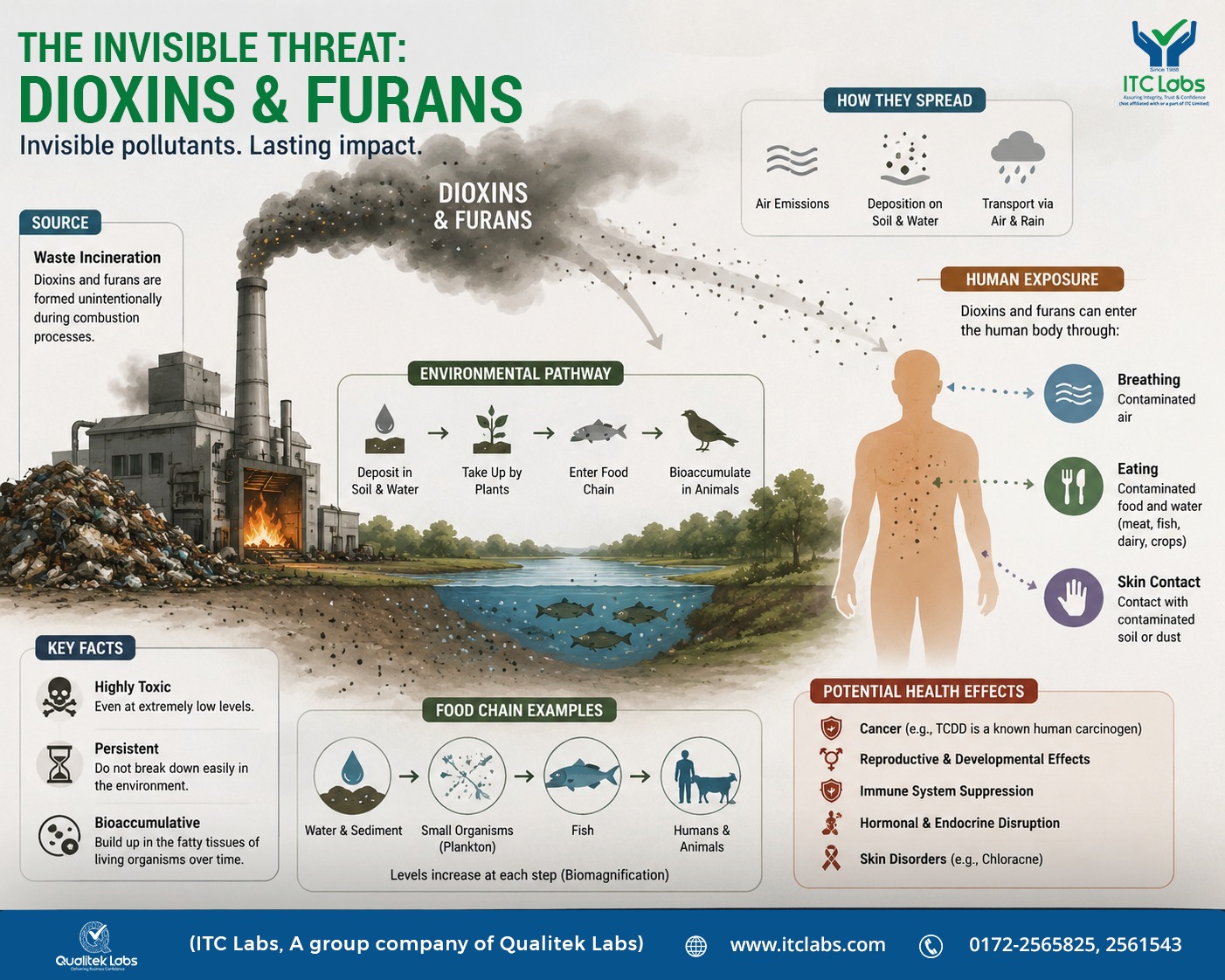
The real problem with these compounds is that the environment has no efficient way to get rid of them. They stick around, in soil, in river sediments, in the tissue of fish and livestock. Each step up the food chain, concentrations tend to increase rather than dilute. For humans, that means the exposure isn’t always dramatic or sudden; it builds quietly over the years. Low levels, sustained over time, are what the health literature keeps flagging as the genuine concern here.
What Exactly Are Dioxins and Furans?
Polychlorinated dibenzo-para-dioxins and polychlorinated dibenzofurans are byproducts, not something any industry deliberately manufactures, but compounds that form regardless during certain thermal and chemical processes. Their Persistent Organic Pollutant classification stems from a combination of factors that make them difficult to ignore: they linger in the environment rather than degrade, they accumulate in the fatty tissue of animals and humans, and their carcinogenic and toxic effects surface at concentrations that most other regulated substances don’t approach.
Chemically, dioxins and furans are close but not the same. Dioxins have two oxygen bridges connecting their aromatic rings; furans have one. Within the dioxin family, 2,3,7,8-TCDD is the most toxic congener identified to date. It functions as the international reference standard against which all related compounds are measured in toxicity equivalency frameworks.
Why Are Dioxins and Furans a Concern?
Once released, dioxins and furans don’t go anywhere quickly. They bind to soil, settle in sediments, and resist natural breakdown for decades. Biologically, they accumulate in fat tissue and with each step up the food chain, concentrations increase. That process, biomagnification, means humans typically carry higher loads than the animals they consume.
Where Do Dioxins and Furans Come From?
Most dioxin and furan releases trace back to industrial processes:
- Improper waste incineration
- Wood pulp paper production
- Metal smelting
- Pesticide and herbicide manufacturing
- Vehicle exhaust- a source that contaminates soil and water across roadsides globally
Deliberate production is now restricted in many countries. Even so, imported goods manufactured under different regulatory standards continue to bring these compounds into circulation, turning up in landfills, indoor environments and water systems.
The longer-term problem is migration. Dioxins and furans move from soil and water into the food chain, concentrating in meat and dairy. Human exposure builds quietly through diet over the years. The health effects of dioxins and furans from that kind of accumulated exposure are well-documented. Catching high concentrations early, through proper source monitoring and environmental testing, is the most effective intervention available.
How Do Dioxins and Furans Enter the Human Body?
Most people are exposed to dioxins and furans without realising it. The routes vary, but some are more significant than others:
- Food consumption- Meat, dairy and fatty fish carry the highest concentrations due to bioaccumulation up the food chain
- Air inhalation- particularly near incineration sites, industrial facilities or areas with heavy vehicle traffic
- Soil and dust exposure- Relevant near contaminated land, industrial zones or poorly managed waste sites. Children face a higher risk through incidental ingestion
- Occupational exposure- Workers in waste incineration, metal processing and chemical manufacturing face direct and repeated contact, often at concentrations well above background levels
The health effects of dioxins and furans vary by route and duration, but the underlying pattern is consistent accumulation over time rather than acute single events. That’s what makes ongoing monitoring across all four pathways a practical necessity, not just a regulatory formality.
Health Effects of Dioxins and Furans
Exposure to dioxins and furans doesn’t tend to produce an obvious moment of harm. It works differently, quietly, through accumulated contact over time.
- Cancer risk– among all dioxin congeners, 2,3,7,8-TCDD is the one regulators watch most closely. Classified as a likely human carcinogen by the U.S. EPA, it drives much of the risk conversation around this compound family.
- Hormonal disruption– people with elevated exposure levels have shown hormone changes; the interference runs across endocrine pathways rather than affecting a single hormone.
- Reproductive effects– reduced reproductive success and fetal abnormalities recorded in animal studies; these results have fed directly into human health guidelines across multiple regulatory systems.
- Immune suppression– animal studies show it clearly; dioxin and furan exposure reduces the immune system’s ability to function normally
- Chloracne– a severe skin condition triggered by high-dose exposure, and one of the clearest clinical signals that significant dioxin contact has occurred
What Are Dioxin-Like PCBs?
Polychlorinated biphenyls are a family of 209 synthetic chemical compounds, each defined by the number and position of chlorine atoms attached to a biphenyl backbone. Of these, 12 congeners are classified as dioxin-like PCBs because their three-dimensional molecular structure allows them to bind to the aryl hydrocarbon receptor in the same way 2,3,7,8-TCDD does.
Why Are They Tested Alongside Dioxins and Furans?
In environmental and biological samples, dioxin-like PCBs rarely appear in isolation. Industrial releases, contaminated sediments, and food chain accumulation deliver them alongside PCDD and PCDF congeners as a mixture. Assessing dioxins and furans without accounting for dioxin-like PCBs produces an incomplete toxicity picture, and in many cases, a significant underestimate of actual risk.
Regulatory Requirements for Dioxin and Furan Monitoring
Dioxin and furan regulatory compliance sits across three distinct layers for industries operating in India:
- MoEF&CC– sets the environmental and emission standards industrial facilities must meet.
- CPCB– enforces compliance at ground level; mandates monitoring and reporting for waste, incineration and chemical sectors.
- Industry responsibilities– facilities are expected to monitor actively, test regularly and maintain documentation that holds up to scrutiny at any point.
What Does Dioxin and Furan Testing Involve?
Dioxin testing and furan testing require advanced analytical techniques due to the extremely low concentrations at which these pollutants occur. Samples such as soil, wastewater, sludge, ash, and stack emissions are carefully collected and prepared for analysis.
Testing is typically performed using Gas Chromatography-High Resolution Mass Spectrometry (GC-HRMS), which enables the accurate detection and quantification of dioxins, furans, and dioxin-like PCBs. Results are reported as WHO Toxic Equivalents (WHO-TEQ), providing a standardized measure of overall toxicity.
A qualified dioxin analysis laboratory follows strict quality control and validation procedures to ensure reliable results, helping industries assess environmental risks and meet regulatory requirements.
Samples Commonly Tested for Dioxins and Furans
- Soil
- Sediment
- Sludge
- Wastewater
- Ash
- Stack emissions
Parameters Commonly Tested for Dioxins and Furans
- 2,3,7,8-tetrachlorodibenzo-p-dioxin
- 1,2,3,7,8-pentachlorodibenzo-p-dioxin
- 1,2,3,4,7,8-hexachlorodibenzo-p-dioxin
- 1,2,3,6,7,8-hexachlorodibenzo-p-dioxin
- 1,2,3,7,8,9-hexachlorodibenzo-p-dioxin
- 1,2,3,4,6,7,8-heptachlorodibenzo-p-dioxin
- Octachlorodibenzo-p-dioxin
Furan
- 2,3,7,8-tetrachlorodibenzofuran
- 1,2,3,7,8-pentachlorodibenzofuran
- 2,3,4,7,8-pentachlorodibenzofuran
- 1,2,3,4,7,8-hexachlorodibenzofuran
- 1,2,3,7,8,9-hexachlorodibenzofuran
- 1,2,3,6,7,8-hexachlorodibenzofuran
- 2,3,4,6,7,8-hexachlorodibenzofuran
- 1,2,3,4,6,7,8-heptachlorodibenzofuran
- 1,2,3,4,7,8,9-heptachlorodibenzofuran
- 1,2,3,4,6,7,8,9-octachlorodibenzofuran
Polychlorinated biphenyls (PCB)
- 3,3’4,4’-tetrachlorobiphenyl (PCB-77)
- 3,4,4’,5-tetrachlorobiphenyl (PCB-81)
- 3,3’,4,4’,5-pentachlorobiphenyl (PCB-126)
- 3,3’,4,4’,5,5’-hexachlorobiphenyl (PCB-169)
- 2,3,3’,4,4-pentachlorobiphenyl (PCB-105)
- 2,3’,4,4’,5-pentachlorobiphenyl (PCB-118)
- 2’,3,4,4’,5-pentachlorobiphenyl (PCB-123)
- 2,3,3’,4,4’,5-hexachlorobiphenyl (PCB-156)
- 2,3,3’,4,4’,5’-hexachlorobiphenyl (PCB-157)
- 2,3’,4,4’,5,5’-hexachlorobiphenyl (PCB-167)
- 2,3,4,4’,5-pentachlorobiphenyl (PCB-114)
- 2,2’,3,3’,4,4’,5-heptachlorobiphenyl (PCB-170)
- 2,2’,3,4,4’,5,5’-heptachlorobiphenyl (PCB-180)
- 2,3,3’,4,4’,5,5’-heptachlorobiphenyl (PCB-189)
How ITC Labs Supports Dioxin and Furan Testing
At ITC Labs, we understand the challenges associated with monitoring dioxins and furans. Our dioxin and furan testing services combine advanced analytical techniques with robust quality assurance practices to deliver reliable results. We support industries across sectors by helping them assess environmental risks, monitor emissions, and meet evolving regulatory requirements. Whether for routine monitoring or compliance-driven testing, our team is committed to providing dependable analytical support.
Conclusion
Dioxins and furans may not be visible, but their impact can be long-lasting. Their persistence in the environment and potential health effects make regular monitoring essential. Accurate testing helps industries understand potential risks, meet regulatory obligations, and make informed decisions. By prioritizing effective monitoring and reliable analysis, organizations can play an important role in protecting both public health and the environment.
Frequently Asked Questions (FAQs)
1. What is dioxin testing?
Dioxin testing is the process of detecting and measuring dioxins in environmental and industrial samples. It helps assess contamination levels, support compliance, and evaluate potential environmental and health risks.
2. What is furan testing?
Furan testing involves analyzing samples for the presence of polychlorinated dibenzofurans (PCDFs). It is commonly performed alongside dioxin testing to provide a complete assessment of toxic pollutants.
3. Why are dioxins harmful?
Dioxins are highly toxic compounds that can accumulate in living organisms over time. Long-term exposure has been associated with cancer, hormonal disruptions, reproductive issues, and immune system impairment.
4. How are dioxins and furans formed?
Dioxins and furans are formed unintentionally during industrial activities such as waste incineration, metal processing, chemical manufacturing, and the open burning of chlorine-containing materials.
5. What industries require dioxin testing?
Industries involved in waste management, incineration, chemical manufacturing, metal processing, power generation, and environmental monitoring often require dioxin and furan testing for compliance purposes.
6. What is WHO-TEQ?
WHO Toxic Equivalents (WHO-TEQ) is a standardized method used to express the combined toxicity of different dioxin, furan, and dioxin-like PCB compounds as a single value.
7. How are dioxins and furan samples tested?
Dioxins and furans can be analyzed in various samples, including soil, sediment, sludge, wastewater, ash, stack emissions, industrial waste, and other environmental matrices.
8. Are dioxins regulated in India?
Yes. Dioxins and furans are regulated under environmental guidelines issued by the MoEF&CC and CPCB, with monitoring requirements applicable to several industrial sectors.
9. What is a dioxin analysis laboratory?
A dioxin analysis laboratory is a specialized testing facility equipped with advanced instrumentation and expertise to accurately detect and quantify dioxins, furans, and related compounds.
10. How often should industries conduct dioxin and furan testing?
Testing frequency depends on regulatory requirements, industry type, and emission levels. Industries typically conduct monitoring periodically or as required by environmental permits and compliance programs.

Written by:
Vikrant Saini
Dy. Manager-EWS Division
ITC labs
For more details:
+91 94677-91887
report.environment@itclabs.com