
The protein supplement market has grown considerably — and so has the attention it receives. Regulators, retailers, certification bodies, and end consumers are all looking more closely at what goes into protein powders than they were even five years ago. For manufacturers sitting in the middle of that supply chain, the area drawing the most scrutiny is heavy metal testing.
This isn’t a new issue. But it’s a more urgent one. Detection methods have improved. Acceptable limits have come down. And when contamination makes it into the news cycle, the damage to brands — and entire product categories — is significant. Whey, plant-based, casein, blended formats — no protein source is exempt from the risk. Understanding what heavy metal testing involves and how to integrate it properly is now a fundamental part of manufacturing protein supplements responsibly.
Why Heavy Metals End Up in Protein Powders
Demand for protein supplements isn’t slowing down. Neither is the scrutiny that comes with it. Regulators are updating limits. Retailers are tightening supplier requirements. And consumers are reading ingredient labels and third-party test reports in ways they simply didn’t before. For protein powder manufacturers, all of that pressure tends to land in the same place: heavy metal testing.
The concern itself isn’t new. What’s shifted is how seriously the industry and the regulators watching it. Stricter thresholds, more sensitive instrumentation, and a string of high-profile contamination reports have moved heavy metal testing from a back-burner compliance item to a front-line quality priority. If you’re manufacturing protein powders in any format, this is an area your quality framework needs to address properly.
What Heavy Metal Testing Actually Measures
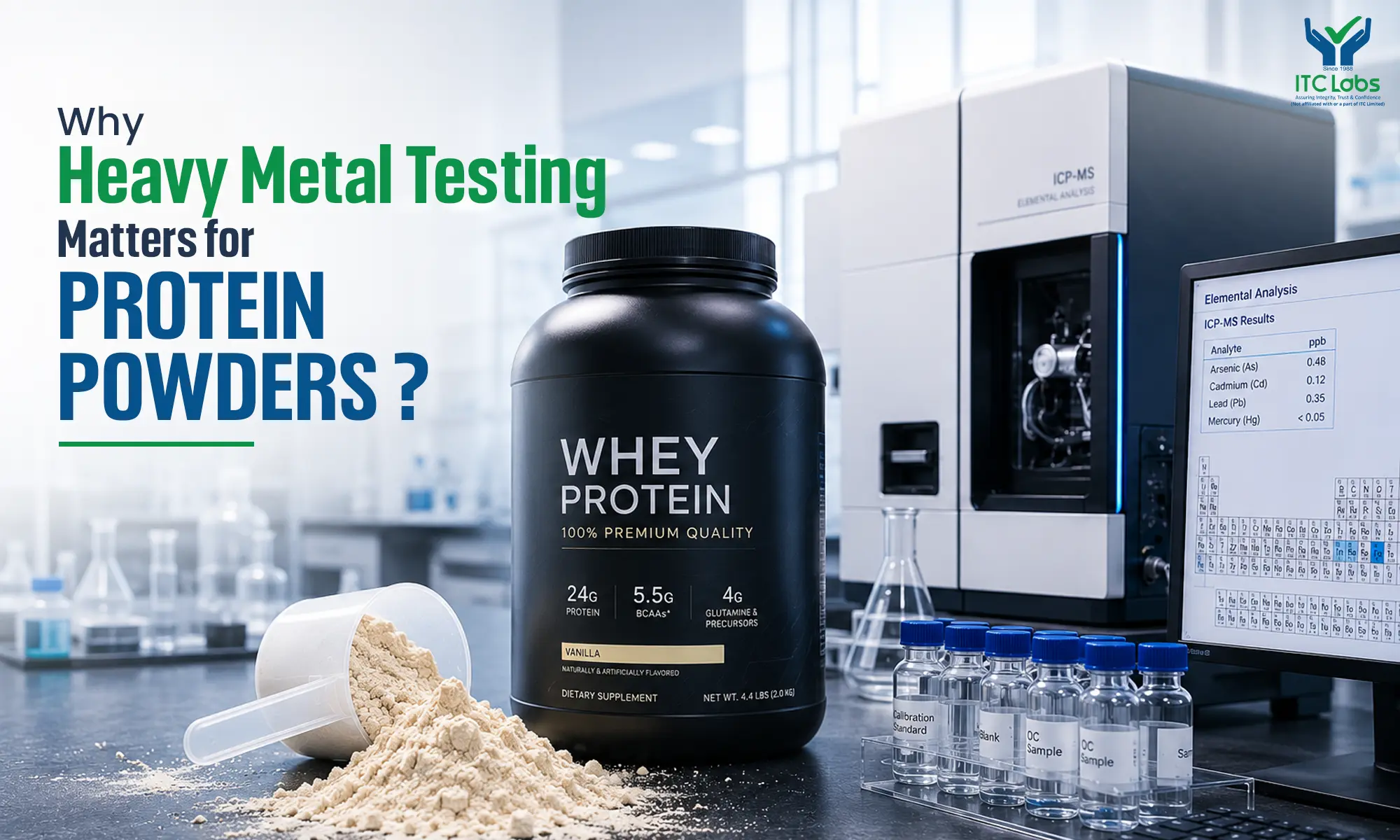
A thorough heavy metal testing programme for protein powders typically screens for four primary metals: lead, cadmium, arsenic, and mercury. These are the metals most commonly associated with health risk at low chronic exposure levels and the ones most regulatory frameworks specifically address.
Testing methods used by a credible heavy metal testing lab include ICP-MS (Inductively Coupled Plasma Mass Spectrometry) and ICP-OES (Inductively Coupled Plasma Optical Emission Spectrometry). ICP-MS in particular is capable of detecting metals at parts-per-billion concentrations — the level of sensitivity required for compliance with most international standards.
Heavy metal testing in food and supplement products also looks at total metal content versus bioaccessible fractions in some frameworks, though for most regulatory purposes, total content remains the standard measurement.
The Regulatory Landscape Manufacturers Are Navigating
There is no single global standard for heavy metals in protein supplements — and that’s exactly what makes compliance complicated. Different markets apply different limits, and manufacturers exporting across borders have to navigate all of them simultaneously.
In India, FSSAI sets limits for heavy metals in food and supplement products. The EU operates under stringent food safety regulations with some of the tightest cadmium and lead thresholds in the world. The US market is increasingly shaped by California’s Proposition 65, which has driven significant reformulation activity among supplement brands.
Third-party certifiers — NSF, Informed Sport, Informed Protein — have their own testing requirements that often sit alongside or above regulatory minimums. If your customers are supplying to professional sports channels or premium retail, those certifications matter commercially, not just from a compliance standpoint.
Working with an accredited testing lab — specifically NABL-accredited labs in India — ensures that your test data is produced under internationally recognised quality frameworks. When a regulatory body or certification auditor questions your results, accreditation is what makes those results defensible.
Building Heavy Metal Testing Into Your Quality Framework
The most common mistake manufacturers make is treating heavy metal testing in protein powders as a finished-product check. By the time contamination shows up in a finished batch, the options are limited — reject, rework, or recall. None of those are good outcomes.
A better approach integrates testing at multiple points. Raw material screening before ingredients enter the facility. In-process checks where relevant. Finished product validation before release. This layered approach catches contamination early, when corrective action is still manageable.
A good quality assurance lab partner will help you design that framework based on your specific ingredients, suppliers, and target markets — not hand you a generic test menu and leave you to figure out the rest.
Manufacturers searching for a heavy metal testing lab near me should also factor in turnaround time as part of their quality framework design. Results that take three weeks don’t support a production schedule that moves in days. Confirm turnaround commitments upfront — and get them in writing.
Start your search with NABL-certified labs near me as a baseline filter — accreditation sets the standard for everything else. From there, evaluate method validation for food matrices, detection limits, internal QA practices, and proficiency testing participation. A trustworthy analytical testing lab answers these questions without hesitation. ITC Labs is exactly that kind of partner. As one of the leading NABL-accredited labs in India, ITC Labs combines advanced instrumentation, experienced professionals, and a quality-driven approach to heavy metal testing in protein powders — supporting manufacturers from incoming raw material screening right through to finished product release, with the reliability and turnaround that a working production environment demands.
Frequently Asked Questions
1. What is heavy metal testing in protein powders?
Heavy metal testing identifies toxic metals like lead, cadmium, arsenic, and mercury in protein powders to ensure product safety, regulatory compliance, and consistent manufacturing quality standards.
2. Why is heavy metal testing important for manufacturers?
Heavy metal testing helps manufacturers reduce contamination risks, meet regulatory requirements, maintain consumer trust, avoid recalls, and ensure protein powders remain safe for market distribution.
3. Which heavy metals are commonly tested in protein supplements?
Protein powders are commonly tested for lead, cadmium, arsenic, and mercury, as these metals are associated with contamination risks and strict food safety regulations globally.
4. Why are plant-based protein powders more vulnerable to contamination?
Plant-based proteins like pea, rice, and soy can absorb heavy metals from soil and water during cultivation, increasing contamination risks compared to some other protein sources.
5. Which methods are used for heavy metal testing in protein powders?
Accredited laboratories commonly use ICP-MS and ICP-OES techniques for heavy metal testing, enabling accurate detection of trace metal contamination in food and protein supplements.
6. Why should manufacturers choose NABL-accredited labs?
NABL-accredited labs follow recognised quality systems and validated testing methods, ensuring reliable, traceable, and globally accepted test reports for regulatory and compliance requirements.
7. How often should manufacturers conduct heavy metal testing?
Manufacturers should perform heavy metal testing regularly on raw materials, in-process samples, and finished products to maintain consistent quality and reduce contamination risks.
8. What should manufacturers look for in a Heavy Metal Testing Lab?
Manufacturers should evaluate accreditation, testing capabilities, turnaround time, instrumentation, detection limits, and experience in heavy metal testing in food and protein supplements before selecting a lab.