
A Complete Guide for Independent Milk Producers & Vendors in India
If you are a milk producer or vendor wondering how to apply for your FSSAI milk licence, here is the straightforward answer: identify your licence type, complete your milk testing, gather the required documents, submit your online application, pay the fee, and clear the FSSAI inspection. But there is more to it than just ticking boxes. Milk testing is the foundation of the entire process — and getting it right from the very first step is what separates businesses that breeze through the FSSAI process from those that face delays, rejections, or penalties.
In this blog, we walk you through each step in plain, simple language — covering everything from the dairy milk testing procedure to choosing the right food testing lab, understanding what NABL accredited labs in India check, and how reliable food testing services keep your dairy business compliant every single day.
Why the FSSAI Milk Licence Is No Longer Optional
India is the world’s largest producer of milk, generating over 230 million metric tonnes annually. Yet a large portion of this milk reaches consumers through informal, unregulated channels — with no milk testing procedure, no verification from a food analysis laboratory, and no FSSAI licence in sight. That changed when FSSAI issued a landmark advisory directing all milk producers not affiliated with dairy cooperatives, as well as independent milk vendors, to obtain mandatory registration or a licence before continuing their operations.
This was not a routine regulatory update. It was a direct response to alarming levels of milk adulteration across the country. Studies by food safety authorities have found common adulterants such as water, starch, urea, detergents, and even formalin in unregulated milk supply chains. For consumers — especially children, the elderly, and people with health conditions — contaminated milk poses serious, life-threatening risks.
For your business, the consequences of non-compliance are equally serious: hefty fines, business shutdowns, product seizures, and reputational damage. Getting your FSSAI milk licence is not just about avoiding punishment — it is about building a sustainable, trustworthy dairy business.
Registration vs. Licence: Which One Does Your Milk Business Need?
Before you begin the application process, you need to understand which category your dairy business falls under. FSSAI has three tiers of authorisation based on annual turnover:
| Business Type | Annual Turnover | Required Authorisation |
| Petty Milk Vendor / Small Farmer | Up to Rs. 12 lakh/year | Basic Registration |
| Small/Medium Milk Producer | Rs. 12 lakh to Rs. 20 crore/year | State Licence |
| Large Dairy Producer / Processor | Above Rs. 20 crore/year | Central Licence |
Choosing the wrong category is one of the most common mistakes first-time applicants make. When in doubt, always choose the higher category — being over-compliant is always safer than facing rejection or legal action later.
The 5 Steps to Apply for Your FSSAI Milk Licence
Step 1: Get Your Milk Tested at an Accredited Testing Lab
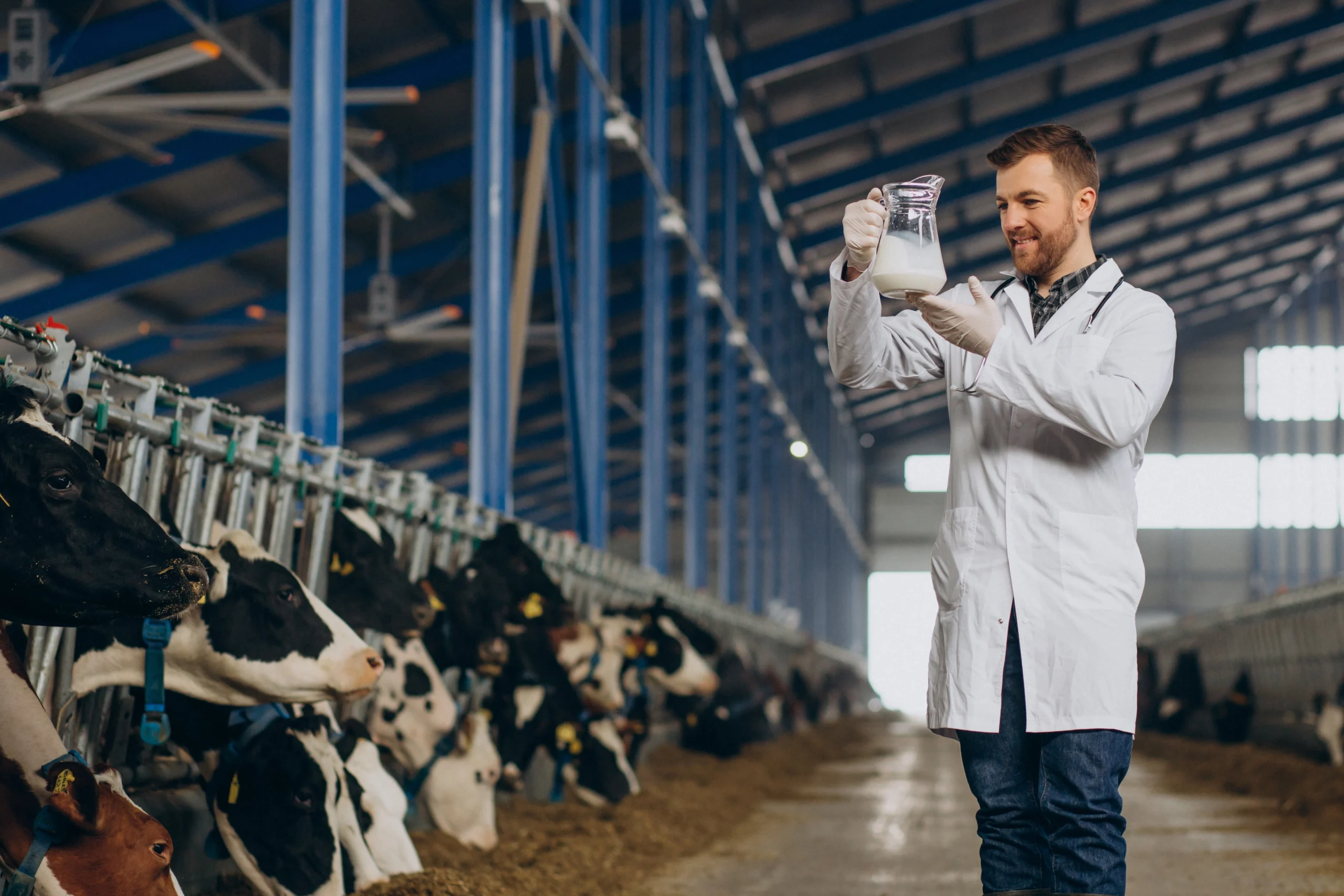
This is the step most people overlook — and it is the most important one. Before applying for your FSSAI licence, your milk must meet the quality standards set under the Food Safety and Standards (Food Products Standards and Food Additives) Regulations, 2011. That means getting a proper milk testing procedure done at a certified, accredited testing lab before you submit a single document.
A professional food testing lab performing dairy milk testing will typically analyse the following parameters:
- Fat content — verified as per milk type (full cream, toned, double toned, skimmed)
- Solid Not Fat (SNF) levels
- Adulteration screening — water addition, starch, sugar, urea, formalin, detergents
- Antibiotic and pesticide residue detection
- Microbial load — Total Plate Count, Coliform bacteria, E.coli, Salmonella
- Aflatoxin M1 — a dangerous mycotoxin that passes from contaminated animal feed directly into milk
- Heavy metals and preservative detection
Why does this matter before applying? Because FSSAI Food Safety Officers can request test reports as part of the verification and inspection process. Having a clean, recent report from a quality assurance laboratory — especially an analytical testing laboratory with NABL accreditation — immediately signals to inspectors that your business takes food safety seriously.
Pro Tip: When searching for a milk testing laboratory near me, always choose a lab accredited by NABL (National Accreditation Board for Testing and Calibration Laboratories) or one recognised by FSSAI. Reports from NABL accredited labs carry official legal weight and are accepted by FSSAI inspectors, regulatory bodies, and export certification authorities. ITC Labs is one such trusted food testing lab offering comprehensive dairy milk testing services.
Step 2: Gather All the Required Documents
Once your milk testing report is ready and your milk meets FSSAI standards, it is time to compile your documentation. Incomplete paperwork is one of the most common reasons for FSSAI application delays. Here is what you will typically need:
- Government-issued photo identity proof (Aadhaar Card, PAN Card, or Voter ID)
- Proof of business address — rent agreement, utility bill, or property documents
- Recent passport-size photograph of the applicant
- Complete list of food products — for example, raw milk, pasteurised milk, cream, or paneer
- Milk testing report from an accredited food analysis laboratory (strongly recommended for all categories, mandatory for inspections)
- Food safety management plan — required for State and Central licence applicants
- NOC from the local municipality or Gram Panchayat — applicable in several states
- Bank account details and cancelled cheque (for certain licence categories)
Keep all documents ready as clear scanned copies in PDF or JPEG format, as the online FSSAI application system requires digital uploads. Most files must be under 2 MB per document.
Step 3: Submit Your Online FSSAI Application
FSSAI has fully digitised its licensing process through a dedicated online portal. This means you can apply for your FSSAI milk licence online from anywhere in India — no physical office visits required for the initial application.
Here is how to complete your online application:
- Create your account on the official FSSAI food licensing portal using your mobile number and email ID.
- Log in and select ‘Apply for Licence/Registration’ from the main dashboard.
- Choose your business type (petty vendor, manufacturer, transporter, storage, etc.) and select the correct licence category based on your turnover.
- Fill in all required details about your dairy premises, production capacity, and the types of milk products you handle.
- Upload your scanned documents, including your milk testing report from your food testing lab.
- Review your entire application carefully before final submission to avoid errors that can cause delays.
Once submitted, you will receive an Application Reference Number (ARN). Save this carefully — you will use it to do an FSSAI milk licence check at any time to track your application status and view your approval progress.
Step 4: Pay the Application Fee
FSSAI application fees are affordable and structured by licence category. Here is a quick overview:
- Basic Registration: Rs. 100 per year
- State Licence: Rs. 2,000 to Rs. 5,000 per year, depending on the type and scale of dairy operations
- Central Licence: Rs. 7,500 per year
Payments are made securely online via net banking, credit or debit card, or UPI. After payment, download and preserve your payment receipt — it is proof that your application has been formally submitted.
Step 5: Clear the FSSAI Inspection and Receive Your Licence
After submission and payment, FSSAI assigns a Food Safety Officer (FSO) to conduct a physical inspection of your dairy premises. For State licences, this typically happens within 30 days. The FSO will evaluate your hygiene conditions, storage facilities, and may ask to review your milk testing records and food testing documentation.
Once approved, your FSSAI licence or registration certificate is issued digitally. This certificate must be displayed prominently at your place of business at all times. You can also do an FSSAI milk licence check on the official portal to view your certificate, check your licence expiry date, and monitor compliance history.
Important: Getting the licence is not the finish line — it is the starting point. FSSAI requires ongoing compliance, which means your milk must continue to meet quality standards throughout the licence period. Regular dairy milk testing from a trusted food testing lab is the only way to guarantee this.
How a Food Testing Lab Supports Your FSSAI Compliance Journey
Many milk producers treat milk testing as a one-time formality — something you do before applying, then forget about. This is a costly misconception. A trusted partnership with an accredited food testing lab is what keeps your business safe, compliant, and inspection-ready every single day.
Here is how food testing services support your dairy business at every stage:
- Pre-licence testing: Confirm your milk meets all FSSAI standards before you submit your application — no surprises during inspection.
- Routine quality monitoring: Periodic dairy milk testing helps detect problems — like sudden drops in SNF or unexpected microbial spikes — before they ever reach your customers.
- Shelf-life determination: An analytical testing laboratory can run accelerated stability tests to determine exactly how long your milk and milk products remain safe for consumption.
- Nutritional labelling support: If you sell packaged dairy products, a food analysis laboratory generates accurate nutritional data for your labels — a mandatory FSSAI requirement for packaged food.
- Contaminant and residue screening: From antibiotic residues and pesticides to heavy metals and mycotoxins, a quality assurance laboratory identifies invisible threats that no visual check can catch.
- FSSAI audit preparedness: NABL accredited labs in India issue legally recognised test reports that FSSAI inspectors, state food safety authorities, and export certification bodies accept without question.
Real-world example: A small dairy business in Maharashtra was found selling milk with elevated coliform counts during a routine FSSAI inspection. Because they had no ongoing testing records from a certified food testing lab, they could not prove it was an isolated incident. Their licence was suspended for 30 days, causing significant revenue loss. Had they been conducting monthly dairy milk testing through a food analysis laboratory, they would have detected and corrected the issue internally — long before any inspector arrived.
Why Choose a NABL Accredited Lab for Milk Testing?
When you search for a milk testing laboratory near me, you will find many options. But not all labs are equal — and choosing the wrong one can mean your test reports carry no weight during an FSSAI inspection. NABL accreditation is the gold standard for food testing labs in India, and here is why it matters:
- Test reports from NABL accredited labs are legally recognised by FSSAI, APEDA, and export regulatory bodies.
- These labs follow internationally aligned testing methods based on ISO/IEC 17025 standards.
- Results are reproducible, traceable, and defensible — critical in case of regulatory disputes or product recalls.
- NABL accredited labs undergo regular third-party audits, ensuring the accuracy and reliability of every milk testing procedure they conduct.
- Their scope of accreditation is publicly verifiable, so you always know exactly which tests are officially certified.
Whether you need basic adulteration checks or comprehensive food analysis laboratory services covering microbiology, residues, nutritional profiling, and contaminants — always verify the lab’s NABL accreditation scope before sending your samples. This single step can save your business from major compliance headaches down the line.
Common Mistakes to Avoid During Your FSSAI Milk Licence Application
- Choosing the wrong licence category: Applying for Basic Registration when your turnover qualifies for a State Licence can result in rejection and force you to restart the entire process.
- Skipping milk testing before applying: Submitting an application without any food testing documentation leaves you vulnerable during inspection.
- Using an unaccredited lab: Reports from labs that are not NABL accredited or FSSAI recognised hold no official legal weight.
- Uploading incomplete or unclear documents: A blurry scan of your Aadhaar or a missing address proof is enough to delay your application by weeks.
- Ignoring licence renewal: FSSAI licences expire. Continuing to sell milk after expiry is treated as a fresh violation with steep penalties.
- Treating milk testing as a one-time event: Ongoing food testing services are your strongest protection against surprise FSSAI inspections and product recalls.
Why Choose ITC Labs for Your Milk Testing and Food Testing Needs?
Every step of your FSSAI milk licence journey — from pre-application testing to ongoing compliance monitoring — requires a food testing lab partner you can completely trust. That is where ITC Labs makes all the difference.
ITC Labs is a fully accredited food testing laboratory, recognised by NABL, FSSAI, APEDA, and several other leading regulatory bodies. This multi-body accreditation assures clients that every test report issued by ITC Labs meets the highest standards of precision, reliability, and regulatory compliance — from basic food analysis to complex testing requirements. Whether you are preparing for your first FSSAI inspection or managing a large-scale dairy operation, ITC Labs delivers results that stand up to scrutiny.
Here is what sets ITC Labs apart as your preferred analytical testing laboratory:
- Complete dairy milk testing — fat, SNF, adulteration detection, microbiology, antibiotic residues, aflatoxin M1, and more
- Targeted food testing services for bakery goods, oils and fats, spices, nutraceuticals, and a wide range of food categories
- Shelf-life testing, allergen analysis, contaminant detection, and nutritional labelling support — all under one roof
- End-to-end support from product development through to market entry and ongoing FSSAI compliance
- State-of-the-art quality assurance laboratory infrastructure designed for both routine and advanced food analysis
- Trusted by dairy businesses, food manufacturers, and exporters across India for accurate, legally recognised test reports
When you search for a dependable milk testing laboratory near me, or need a certified food analysis laboratory for end-to-end FSSAI compliance, ITC Labs delivers the accuracy, expertise, and regulatory credibility your dairy business needs to grow with confidence.
Ready to get FSSAI compliant? Contact ITC Labs today — your trusted partner for milk testing, dairy compliance, and food safety.
Conclusion
Applying for your FSSAI milk licence does not need to be complicated. By following these five clear steps — getting your milk tested at an accredited testing lab, preparing your documents, submitting your online application, paying the fee, and maintaining ongoing compliance — you can bring your dairy business fully into the formal, regulated economy. Most importantly, by partnering with a trusted food testing lab like ITC Labs for regular dairy milk testing, you ensure that every litre of milk you sell is safe, compliant, and worthy of your customers’ trust.
India’s dairy industry is growing rapidly. Consumers are better informed, inspectors are more vigilant, and the market rewards businesses that put quality first. Your FSSAI licence — supported by consistent food testing services from a recognised analytical testing laboratory — is not just a legal requirement. It is your most powerful business credential.
Frequently Asked Questions (FAQs)
Q1. Is FSSAI registration mandatory for all milk vendors, even very small ones?
Yes, absolutely. Under the Food Safety and Standards Act 2006 and the recent FSSAI advisory, every food business operator involved in milk production or vending — regardless of scale — must obtain either Basic Registration or a Licence. There is no exemption based on how small your operation is. Even if you supply just a few litres per day, you are legally required to be registered.
Q2. What exactly is the dairy milk testing procedure in an accredited lab?
A certified food analysis laboratory follows standardised methods prescribed by BIS, FSSAI, and AOAC. The dairy milk testing procedure covers fat and SNF analysis using Gerber or infrared methods, adulteration screening via chemical assays, microbiological testing including Total Plate Count and coliform detection, and residue testing for antibiotics, pesticides, and aflatoxin M1. All methods are validated to ISO/IEC 17025 standards, ensuring results are accurate, reproducible, and legally recognised.
Q3. How can I check the status of my FSSAI milk licence application?
You can do an FSSAI milk licence check by logging into the official FSSAI food licensing portal with your credentials. Navigate to ‘Track Application Status’ and enter your Application Reference Number (ARN). The system provides real-time updates on whether your application is under review, pending inspection, or approved. You can also view and download your licence certificate once it is issued.
Q4. How often should milk producers get their milk tested?
FSSAI recommends that dairy businesses maintain regular internal quality checks as part of their Food Safety Management System. For most milk producers and vendors, monthly testing from a quality assurance laboratory is the minimum advisable frequency. Seasonal changes, new animal feed sources, changes in herd health, and variations in water supply can all impact milk quality. Only consistent food testing services from a trusted milk testing lab will catch these variations before they become compliance issues.
Q5. Can I use any laboratory for my milk testing, or does it need to be NABL accredited?
For routine internal monitoring, you may use any lab. However, for test reports you intend to submit during your FSSAI application or inspection, the reports must come from a NABL accredited lab or a lab officially recognised by FSSAI. Reports from unrecognised labs carry no legal standing and will not be accepted as compliance evidence. ITC Labs is a NABL accredited, FSSAI recognised food testing lab that provides comprehensive milk testing services — making it the ideal partner for dairy businesses seeking both quality and compliance.
Take the step today. Get tested, get licensed, and get ahead.