
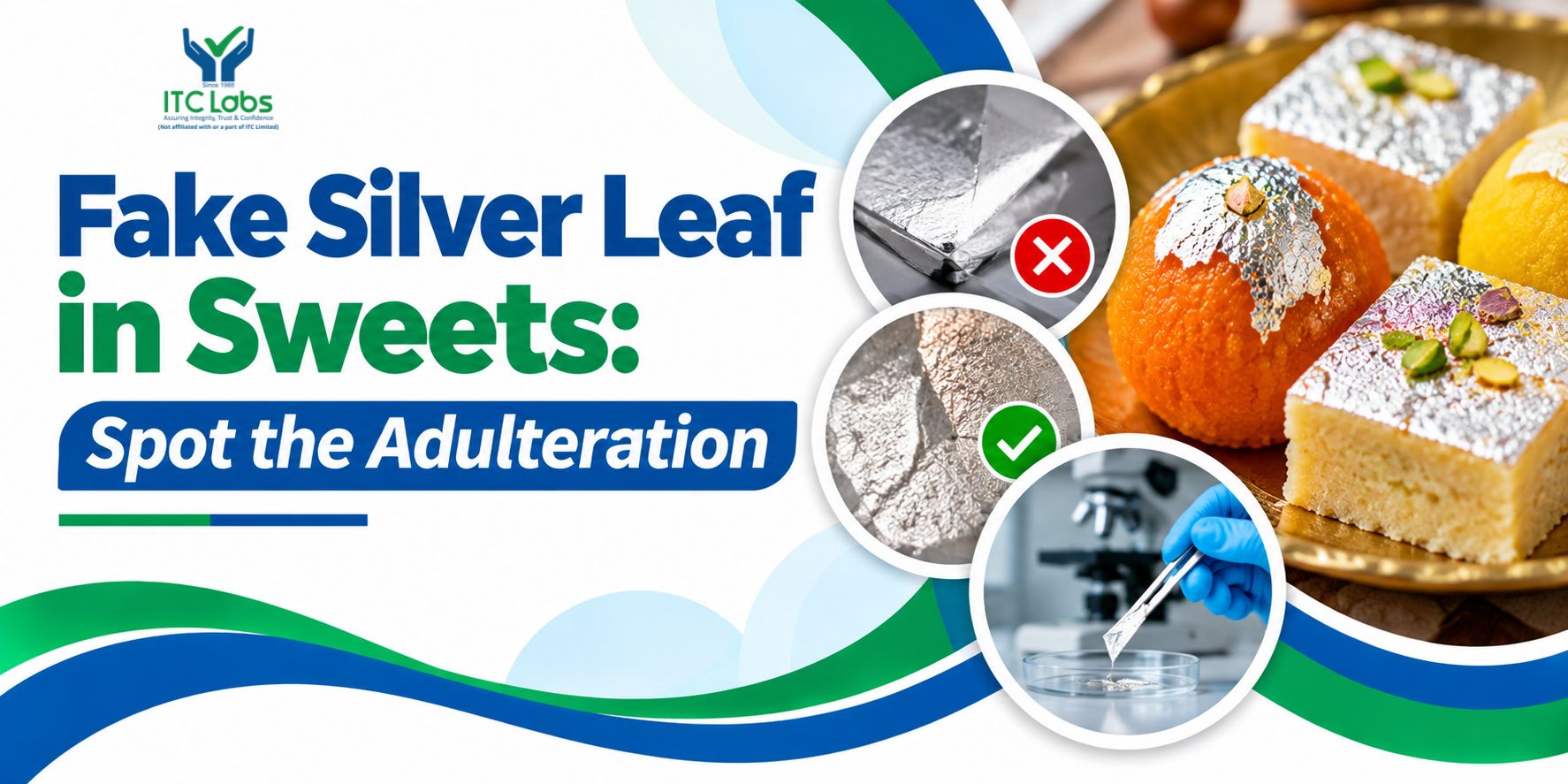
Indian sweets are an essential part of festivals, weddings, celebrations, and everyday traditions. From kaju katli and barfi to peda, rasgulla, and other traditional delicacies, many sweets are decorated with a thin, shiny metallic coating commonly known as Chandi Ka warq or silver leaf. This decorative layer enhances the appearance of sweets and gives them a premium look.
However, not every shiny metallic leaf used on sweets is necessarily genuine edible silver. In some cases, aluminium foil or aluminium-based material may be misrepresented or substituted for silver leaf. This practice raises concerns about food authenticity, product quality, and consumer safety.
The use of non-genuine metallic materials in place of edible silver can be considered a form of food adulteration or misrepresentation. Since aluminium and silver are two different metals with different chemical properties, consumers and manufacturers should understand how to distinguish them.
This is where Aluminium foil detection in sweets, silver leaf analysis, and laboratory-based food adulteration testing become important. Proper testing helps manufacturers, food businesses, regulatory authorities, and consumers establish whether the metallic coating used on sweets is genuine silver or another material.
In this article, we explain what aluminium leaf sold as silver leaf means, the difference between genuine silver warq and aluminium foil, identification methods, and the importance of laboratory testing.
What Is Aluminium Leaf Sold as Silver Leaf in Sweets?
Aluminium leaf sold as silver leaf refers to a thin sheet of aluminium or aluminium-based metallic material that is presented or used as edible silver leaf (Chandi Ka Warq) on sweets.
Genuine silver leaf is traditionally manufactured by beating silver into extremely thin sheets. It is used as a decorative coating on Indian sweets, dry fruits, and certain traditional food products.
Aluminium foil, on the other hand, is made from aluminium metal. Although it may have a similar shiny, silvery appearance, it is chemically different from genuine silver leaf.
When aluminium material is deliberately represented as edible silver, it can mislead consumers and compromise food authenticity. The appearance of the material alone cannot establish its identity or suitability for consumption.
Therefore, silver leaf testing in sweets is important for verifying the actual metallic composition of the decorative coating.
Why Is Aluminium Used as a Substitute for Silver Leaf?
Genuine silver is a valuable metal, and producing edible silver leaf requires specialised manufacturing processes. Aluminium is generally less expensive and also has a bright, metallic appearance.
These characteristics may create an incentive for dishonest suppliers or manufacturers to substitute aluminium-based material for genuine silver leaf.
Some possible reasons behind such substitution include:
-
- Lower production costs: Aluminium is less expensive than silver.
-
- Similar appearance: Both materials have a shiny, silver-coloured surface.
-
- Consumer confusion: Most consumers cannot identify the metal simply by looking at a decorated sweet.
-
- Economic benefits: Substitution may increase profit margins through misrepresentation.
-
- Lack of verification: Businesses that do not conduct proper raw-material testing may unknowingly purchase incorrectly labelled materials.
However, the use of aluminium as a substitute for genuine edible silver should not be confused with the use of aluminium packaging. Aluminium foil used for packaging and edible silver leaf used as a food decoration serve different purposes.
Silver Leaf vs Aluminium Foil: Key Differences
Understanding the difference between genuine silver leaf and aluminium foil is essential for sweet manufacturers, distributors, retailers, and consumers.
| Parameter | Genuine Silver Leaf | Aluminium Foil |
|---|---|---|
| Material | Pure silver | Aluminium metal |
| Appearance | Bright, silvery metallic finish | Shiny metallic finish |
| Chemical composition | Silver (Ag) | Aluminium (Al) |
| FSSAI silver leaf standard | Minimum 999/1000 silver fineness | Does not meet the silver leaf standard |
| Crushing behaviour | Breaks down into fine powder | Breaks into smaller shreds |
| Identification | Requires material verification | Requires material verification |
According to FSSAI’s Food Safety and Standards (Food Products Standards and Food Additives) Regulations, food-grade silver leaf must contain a minimum of 999 parts silver per 1,000 parts and meet specified requirements for thickness, weight, and manufacturing. It must also not be manufactured using materials of animal origin at any stage.
This standard makes it important to verify the composition of decorative metallic leaves rather than relying only on their appearance.
How to Identify Fake Silver Leaf in Indian Sweets?
Identifying aluminium leaf sold as silver leaf can be challenging because both materials may look almost identical when applied to sweets. However, certain preliminary checks can help identify suspicious samples.
1. Crushing Test
(i). On ignition, genuine silver leaves burn away completely, leaving a blistering white spherical ball of the same mass, whereas aluminium leaves are reduced to ashes of dark grey-blackish colour.
(ii). Take silver leaves in a test tube and add diluted hydrochloric acid. Appearance of turbidity or white precipitate indicates the presence of silver leaves. Aluminium leaves do not give any turbidity or precipitate.
(iii). Take aluminium leaves in the palm and rub between both palms of the hand. Silver leaves completely disappear in the hand; however, the presence of a small ball in the palm indicates adulteration with aluminium leaves.
2. Burning Test
FSSAI’s DART guidance also describes a burning test for suspected leaf material.
Genuine silver leaves are described as burning away completely, leaving glistening balls.
Aluminium leaves are described as reducing to grey ash.
This is a screening method, not a definitive laboratory identification. Consumers should not attempt burning tests on sweets or unknown materials because of fire, burn, and fume hazards. Such checks should only be performed by trained personnel using appropriate precautions.
3. Visual Inspection
Visual examination may help identify irregularities, but it cannot reliably establish whether the material is silver or aluminium. Differences in shine, texture, thickness, and tearing behaviour are not conclusive.
4. Laboratory Analysis
Laboratory testing is the most reliable approach to confirming the metallic composition. Analytical methods can identify and quantify elements present in the sample, helping determine whether the decorative coating meets the applicable silver leaf requirements.
For commercial decisions, regulatory compliance, or suspected adulteration, laboratory analysis should be preferred over household identification methods.
Looking for Reliable Silver Leaf and Aluminium Adulteration Testing?
Ensure the authenticity and purity of decorative metallic leaves used in sweets with professional food testing services from ITC Labs. Identify possible aluminium substitution, verify silver content, and maintain food quality and compliance with applicable FSSAI standards through reliable laboratory analysis.
Importance of Silver Leaf Testing in Sweets
Silver leaf testing in sweets plays an important role in maintaining product quality, consumer confidence, and food authenticity.
Sweet manufacturers often purchase silver leaf from third-party suppliers. Without appropriate verification, there is a possibility that an incorrectly labelled or substituted material may enter the production chain.
Regular testing helps businesses:
-
- Verify the authenticity of silver leaf purchased from suppliers.
-
- Identify aluminium or other metallic substitutions.
-
- Check whether silver content meets the applicable FSSAI standard.
-
- Maintain the quality and authenticity of finished sweets.
-
- Reduce the risk of misleading product claims.
-
- Support regulatory compliance and quality assurance.
-
- Build consumer trust through transparent sourcing and testing.
Chandi ka Warq testing is particularly important for manufacturers of premium sweets, traditional Indian confectionery, and products decorated with metallic edible coatings.
How Is Aluminium Foil Detection in Sweets Performed in a Laboratory?
An Aluminium detection laboratory can use appropriate analytical techniques to identify the metallic elements present in a suspected sample.
The exact testing method depends on the sample type, the quantity of metallic coating available, and the required analytical parameters.
1. Sample Collection and Preparation
The laboratory collects a representative sample of the decorated sweet or the metallic leaf. Where possible, the metallic coating is carefully separated from the sweet matrix to minimise interference from other ingredients.
2. Elemental Analysis
Elemental analysis helps identify the metals present in the sample. Techniques such as Inductively Coupled Plasma Optical Emission Spectrometry (ICP-OES), Inductively Coupled Plasma Mass Spectrometry (ICP-MS), or Atomic Absorption Spectroscopy (AAS) may be selected according to the testing requirement and validated laboratory procedure.
3. Identification of Silver and Aluminium
The analytical results can help establish whether silver, aluminium, or other metals are present in the tested material.
The presence of aluminium alone does not necessarily establish deliberate adulteration. Interpretation must consider the sample preparation, background contamination, material composition, and the purpose of the analysis.
4. Silver Content Verification
For genuine silver leaf, testing should also evaluate whether the silver content complies with the applicable minimum fineness requirement of 999/1000.
5. Reporting and Interpretation
After completing the analysis, the laboratory provides a test report containing the relevant analytical findings. These results can help manufacturers and food businesses assess material authenticity and compliance.
A properly selected analytical method is essential for reliable aluminium foil detection in sweets and silver leaf purity verification.
What Is Silver Foil Purity Testing and Why Does It Matter?
Silver foil purity testing is the process of determining the actual silver content and composition of a metallic leaf used as an edible decorative material.
According to FSSAI requirements, food-grade silver leaf must have a minimum silver content of 999/1000 fineness. This means the material must contain at least 99.9% silver.
Purity testing is important because a metallic sheet may appear silver-coloured without actually being made of genuine silver.
Testing helps determine:
-
- Whether the material contains genuine silver.
-
- Whether the silver content meets the prescribed purity requirement.
-
- Whether aluminium or other metals are present.
-
- Whether the material is suitable for its intended food application.
-
- Whether the supplier’s product specifications are accurate.
For manufacturers, distributors, and suppliers, regular silver foil purity testing helps maintain quality standards and minimise the risk of purchasing adulterated raw materials.
Food Adulteration Testing: Protecting Consumers from Metallic Foil Adulteration
Food adulteration is a major concern for the food industry because it can affect product quality, authenticity, and consumer confidence.
Metallic foil adulteration in sweets and confectionery is particularly concerning because consumers generally associate the shiny decorative coating with genuine edible silver.
When aluminium or another non-genuine material is misrepresented as silver leaf, consumers may unknowingly purchase products that do not meet their expected quality and authenticity standards.
Food adulteration testing helps identify such practices through scientific examination of food samples and their ingredients.
Some important benefits include:
-
- Detection of substituted or misrepresented ingredients.
-
- Verification of raw material authenticity.
-
- Identification of metallic contaminants.
-
- Improved supplier quality control.
-
- Support for food safety compliance.
-
- Protection of consumer interests.
Food businesses should establish proper quality control procedures and purchase decorative metallic leaves only from reliable suppliers who can provide appropriate product specifications and supporting documentation.
Why Choose a Professional Food Testing Laboratory?
Although preliminary identification methods can provide useful indications, they cannot replace scientific laboratory analysis.
A professional food testing laboratory has the analytical infrastructure, trained technical personnel, and appropriate testing methods required to examine food samples.
Before selecting a laboratory, food businesses should consider:
-
- NABL accreditation under ISO/IEC 17025.
-
- FSSAI approval or notification, as applicable.
-
- Availability of relevant testing parameters within the laboratory’s accredited scope.
-
- Appropriate analytical instruments and validated methods.
-
- Qualified technical and scientific personnel.
-
- Reliable reporting and interpretation of results.
Choosing the right laboratory is important because accurate testing results help businesses make informed decisions about raw material procurement, product quality, and regulatory compliance.
Conclusion: Ensure Authenticity of Silver Leaf with ITC Labs
Identifying aluminium leaf sold as silver leaf is important for maintaining food authenticity, product quality, and consumer confidence. Since aluminium and genuine silver may have a similar appearance, visual inspection alone is not sufficient to establish the composition of metallic decorative materials.
Whether you are a sweet manufacturer, food processor, raw material supplier, distributor, or retailer, regular Silver leaf testing in sweets and aluminium detection can help you maintain quality standards and minimise the risk of metallic foil adulteration.
For reliable food analysis and quality verification, choosing an experienced and appropriately accredited laboratory is essential.
ITC Labs offers comprehensive food testing services supported by modern analytical facilities, technical expertise, and recognised accreditations.
Why Choose ITC Labs for Food Testing?
ITC Labs has the following accreditations and recognitions:
-
- NABL accreditation under ISO/IEC 17025:2017.
-
- FSSAI Approved Laboratory.
-
- BIS Empanelled.
-
- APEDA Recognised.
-
- Approved for fortified food testing, including rice, milk, oil, and salt.
-
- Recognised by organic certification bodies, including NOP, NPOP, and EU Organic.
-
- Spices Board of India Approved.
-
- Tea Board of India Recognised.
-
- State and Central Government Recognitions.
ITC Labs provides food testing services covering bakery products, oils and fats, spices, dairy products, nutraceuticals, and other food categories. Its testing capabilities support various quality assurance requirements, including shelf-life studies, allergen analysis, contaminant detection, and nutritional labelling. With recognised accreditations and a focus on analytical accuracy, ITC Labs can support food businesses in their quality assurance and regulatory compliance requirements. If you are looking for a reliable Food testing laboratory for food adulteration analysis, metallic composition verification, or other food quality parameters, consider ITC Labs.
Choose ITC Labs to support food quality, authenticity, and consumer safety.
Frequently Asked Questions (FAQs)
Q1. What is aluminium leaf sold as silver leaf in sweets?
Aluminium leaf sold as silver leaf refers to aluminium-based metallic material that is represented or used as genuine edible silver leaf (Chandi Ka Warq). Although both may look similar, their chemical compositions are different.
Q2. How can I identify fake silver leaf in Indian sweets?
Preliminary identification methods include the crushing test and burning test described in FSSAI’s DART guidance. However, these are screening methods. Laboratory analysis is recommended to confirm the actual metallic composition.
Q3. What is the FSSAI purity standard for edible silver leaf?
According to FSSAI regulations, food-grade silver leaf must contain a minimum of 999/1000 silver fineness. It must also meet specified requirements regarding sheet uniformity, weight, and manufacturing.
Q4. Which laboratory tests are used for aluminium foil detection in sweets?
Elemental analysis techniques such as ICP-OES, ICP-MS, and AAS may be used, depending on the sample and analytical requirements. The appropriate method should be selected by the laboratory.
Q5. Why is Chandi Ka Warq testing important for sweet manufacturers?
Chandi Ka Warq testing helps verify the authenticity and purity of decorative silver leaf, identify possible aluminium substitution, maintain product quality, and support compliance with applicable food safety requirements.