
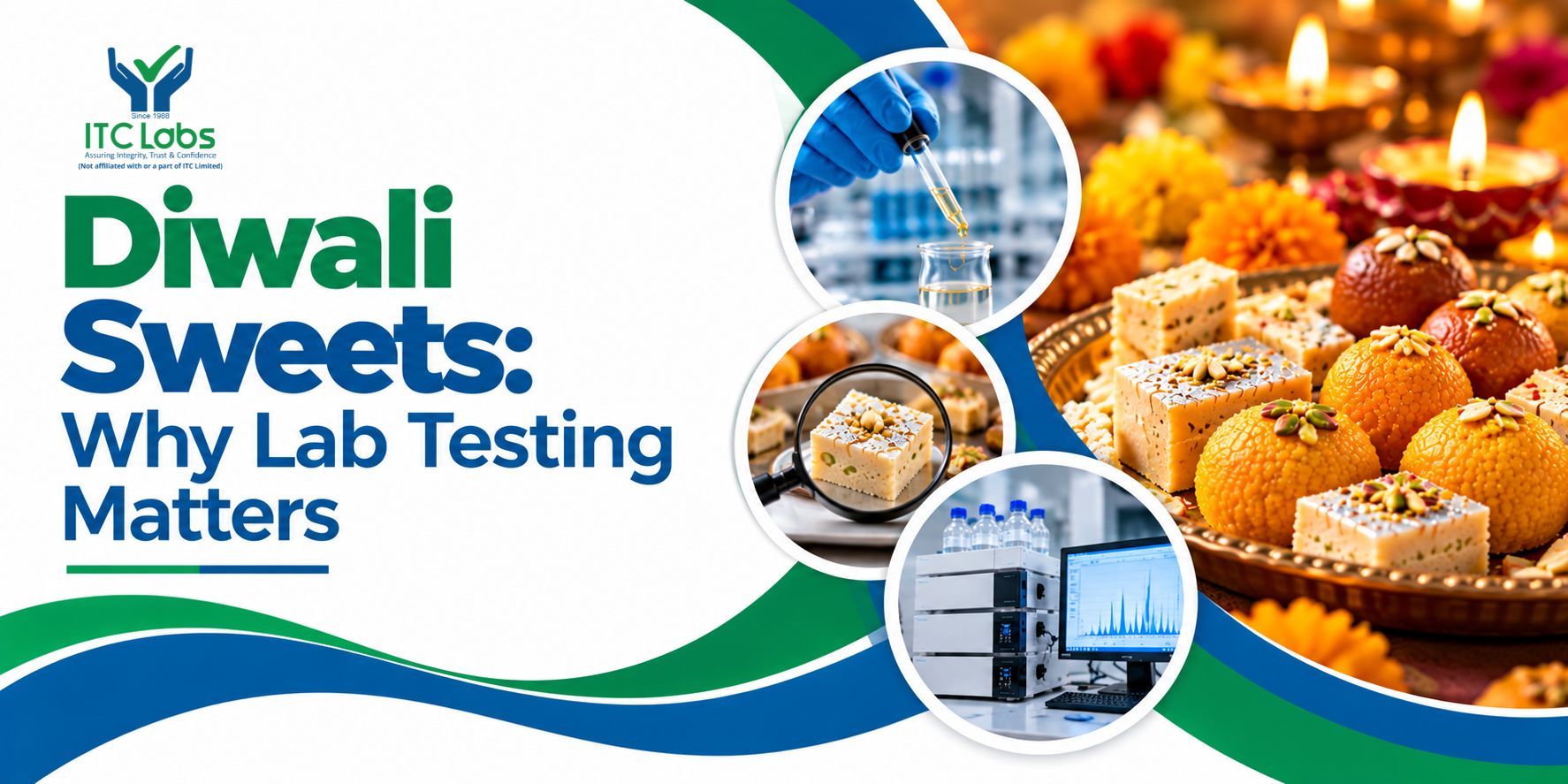
Diwali is a festival of lights, happiness, and, of course, delicious sweets. From the rich taste of Kaju Katli and the traditional flavour of Motichoor Laddoos to the creamy goodness of Barfi and Peda, sweets are an essential part of every Diwali celebration. Families exchange sweet boxes, businesses distribute festive gifts, and sweet shops experience a significant increase in demand.
However, behind these festive delicacies lies an important responsibility: ensuring food safety, purity, and quality. With the increased demand for sweets during the festive season, maintaining consistent quality and preventing adulteration become especially important. This is where food testing laboratories play a vital role in ensuring that Diwali sweets meet applicable food safety and quality standards.
Why Is Diwali Sweets Testing Important?
During Diwali, sweet manufacturers and retailers often operate under pressure to meet rising consumer demand. To maintain quality during this busy period, businesses need to pay close attention to raw materials, manufacturing practices, storage conditions, and finished products.
According to the Food Safety and Standards Authority of India (FSSAI), traditional milk-based sweets are particularly perishable and can be vulnerable to microbial growth if they are not prepared, handled, and stored correctly. FSSAI also highlights concerns relating to adulteration, substandard ingredients, and the use of non-permitted colours or ingredients.
Laboratory testing helps food businesses evaluate their products against relevant safety and quality parameters, identify potential concerns, and make informed decisions before their sweets reach consumers.
1. Detecting Adulteration in Diwali Sweets
Food adulteration is a significant concern for sweets made with ingredients such as milk, khoya (mawa), ghee, edible oils, sugar, and dry fruits. The use of substandard raw materials or unauthorised additives can compromise product quality and, in some cases, consumer safety.
Depending on the product and applicable standards, laboratory testing can help investigate concerns such as:
- Khoya and milk product quality: Testing can assess selected parameters to help identify certain forms of adulteration or non-compliance.
- Ghee and edible oil quality: Analysis can evaluate relevant quality characteristics and investigate potential adulteration.
- Artificial colours and additives: Testing can help determine whether colours or additives comply with applicable requirements.
- Ingredient purity: Selected chemical tests can help assess whether ingredients meet the relevant specifications.
For example, Kaju Katli manufacturers may need to verify the quality of cashews and other ingredients, while milk-based sweets such as Peda and Barfi require careful control of dairy ingredients. The exact tests depend on the recipe, ingredients, product category, and applicable regulatory requirements.
It is important to remember that appearance, smell, and taste alone cannot reliably establish whether a sweet is free from adulteration. Laboratory analysis provides a more objective way to evaluate specific food safety and quality concerns.
2. Microbiological Testing for Safer Sweets
Many popular Indian sweets contain milk, khoya, paneer, cream, or other moisture-rich ingredients. These products may support microbial growth when hygiene, handling, or storage conditions are inadequate.
Microbiological testing can help assess the hygienic quality and safety of sweets by checking appropriate parameters, which may include indicator organisms and specified foodborne pathogens, depending on the product and relevant standards.
This is particularly important for sweets such as:
- Milk-based Barfi and Peda
- Rasgulla and Rasmalai
- Gulab Jamun
- Kalakand and other khoya-based sweets
- Other products requiring controlled storage conditions
Microbiological testing should be supported by good manufacturing practices, clean equipment, safe water, appropriate packaging, and temperature control. A laboratory test is not a substitute for proper hygiene throughout the production and distribution process.
3. Chemical Testing to Verify Quality and Purity
Chemical analysis is another important part of sweets testing. It helps manufacturers evaluate selected characteristics of ingredients and finished products against applicable specifications.
Depending on the product, relevant analyses may include moisture content, fat, acidity, selected contaminants, and other product-specific parameters. Testing for heavy metals or other contaminants may also be appropriate when required by the product’s risk profile or regulatory requirements.
For sweets containing ghee, oils, milk solids, nuts, or other ingredients, appropriate testing can help businesses monitor consistency and investigate potential quality issues.
For manufacturers selling packaged sweets, laboratory analysis can also support nutritional information and help verify declared nutrient values where required.
4. Shelf-Life Testing: Keeping Festive Sweets Fresh
Diwali sweets are often prepared in advance, packed in gift boxes, transported to different locations, and stored before consumption. Without appropriate shelf-life assessment, businesses may struggle to determine how long a product can maintain its intended quality under specified storage conditions.
Shelf-life testing helps evaluate how a sweet changes over time under defined storage conditions. Depending on the product, this may involve assessing:
- Microbiological quality and relevant safety parameters
- Moisture changes and other physical or chemical characteristics
- Changes in texture, colour, flavour, and overall quality
- Packaging performance and its suitability for the product
Milk-based sweets generally require particular attention because their shelf life can be relatively short. The appropriate shelf life must be established for the individual product based on its formulation, manufacturing process, packaging, storage conditions, and supporting test results.
For manufacturers, a well-designed shelf-life study can support more reliable date marking, inventory management, distribution planning, and consumer confidence.
5. Nutritional Labelling and Regulatory Compliance
Consumers increasingly want to know what their food contains, including its energy value, fat, sugar, protein, and other nutritional components.
For businesses selling pre-packaged Diwali sweets, nutritional analysis can help support accurate food labels and assess relevant declarations. Depending on the product and applicable requirements, testing may also support the evaluation of ingredient declarations and specific label claims.
Food businesses should ensure that their products comply with applicable FSSAI requirements and other relevant regulations. Testing requirements can vary according to the type of business, product, and regulatory obligation.
Working with a suitably accredited and appropriately recognised food testing laboratory can help manufacturers obtain reliable analytical results for their quality assurance and compliance programmes.
Looking for Reliable Food Testing Services for Diwali Sweets?
Ensure the safety, purity, and quality of your festive sweets with trusted food testing services from ITC Labs. Get reliable insights into adulteration, microbiological safety, nutritional values, and shelf life.
Who Should Get Diwali Sweets Tested?
Food testing is valuable for more than large sweet manufacturers. Different businesses can benefit from testing according to their products, processes, and risk assessments.
- Sweet manufacturers: To monitor raw materials, finished-product quality, and food safety.
- Sweet shops and retailers: To support supplier quality checks and investigate concerns about purchased products.
- Packaged food brands: To assess nutritional values, product consistency, and shelf life.
- Distributors and food businesses: To strengthen quality assurance across storage and supply chains.
- New food entrepreneurs: To support product development, packaging decisions, and preparation for market entry.
A suitable testing plan should be based on the product’s ingredients, manufacturing process, intended shelf life, applicable standards, and identified risks rather than relying on a single universal testing package.
How to Choose the Right Food Testing Laboratory
Choosing a food testing laboratory is an important step towards building a dependable food safety programme. Before submitting samples, businesses should consider the following factors:
- Accreditation and recognition: Check the laboratory’s current accreditation status and whether the required test parameters fall within its accredited scope.
- Relevant testing capabilities: Confirm that the laboratory can test your specific sweets, ingredients, and required parameters.
- Analytical reliability: Look for appropriate methods, quality controls, and clearly documented test reports.
- Regulatory relevance: Ensure that the tests selected are suitable for the product and applicable regulatory requirements.
- Additional testing services: Consider whether the laboratory can also support shelf-life studies, allergen analysis, contaminant testing, and nutritional labelling.
The right laboratory partner can help food businesses make evidence-based quality decisions, identify areas for improvement, and strengthen consumer trust during the festive season and throughout the year.
Why Choose ITC Labs for Diwali Sweets Testing?
When it comes to food safety, choosing the right laboratory is an important decision for every food business. ITC Labs offers food testing services designed to support quality assurance, product safety, and regulatory compliance across a wide range of food categories.
Key Benefits of Choosing ITC Labs
- Accreditation and recognition: According to the information provided by ITC Labs, the laboratory is recognised by relevant regulatory bodies, including NABL, FSSAI, and APEDA. Businesses should verify the applicable accreditation and recognition scope for their required tests.
- Comprehensive food testing services: ITC Labs supports the testing of dairy products, oils and fats, bakery products, spices, and nutraceuticals, among other food categories.
- Contaminant detection: Appropriate testing can help assess selected contaminants and support the investigation of food safety concerns.
- Shelf-life testing: Product-specific studies can help businesses evaluate quality changes over time and establish suitable shelf-life recommendations.
- Allergen analysis: Testing can support allergen management and relevant food labelling requirements.
- Nutritional analysis and labelling: Analytical services can help food businesses assess nutritional values and support accurate product declarations.
For Diwali sweet manufacturers, retailers, and packaged food brands, these services can form part of a broader quality assurance programme. The specific tests required will depend on the type of sweet, its ingredients, the intended shelf life, and applicable regulatory standards.
By partnering with a suitable food testing laboratory, businesses can make informed decisions about product quality, improve their testing processes, and build greater confidence among consumers.
Conclusion: Celebrate Diwali with Quality and Confidence
From Kaju Katli and Motichoor Laddoos to Barfi, Peda, and other traditional Indian sweets, every festive treat deserves careful attention to food safety and quality. Adulteration checks, microbiological analysis, chemical testing, shelf-life assessment, and nutritional analysis can all contribute to a more reliable food safety programme when selected appropriately for the product.
For sweet manufacturers, retailers, and food businesses, laboratory testing is not just a compliance activity. It is an investment in product quality, consumer confidence, and long-term business credibility.
Choose ITC Labs for your food testing requirements this Diwali. With a range of food testing services, including contaminant detection, shelf-life testing, allergen analysis, and nutritional labelling support, ITC Labs can help your business take a more informed approach to food quality and safety.
Make food safety part of your festive preparations and help ensure that every sweet you share reflects quality, care, and confidence.
Frequently Asked Questions (FAQs)
1. Why is laboratory testing important for Diwali sweets?
Laboratory testing helps evaluate sweets for selected adulterants, microbiological hazards, chemical contaminants, and quality parameters. It supports food safety management and helps manufacturers verify that products meet relevant requirements.
2. Which Diwali sweets should be tested?
Testing may be appropriate for Kaju Katli, Laddoos, Barfi, Peda, Gulab Jamun, Rasgulla, and other sweets, depending on their ingredients and risk profile. Milk-based sweets and products with specific shelf-life or labelling requirements may need particular attention.
3. What tests are commonly performed on Diwali sweets?
Depending on the product, testing may include microbiological analysis, chemical and physicochemical testing, adulteration checks, contaminant analysis, nutritional testing, and shelf-life studies. The appropriate test parameters should be selected according to applicable standards and product requirements.
4. How does shelf-life testing help sweet manufacturers?
Shelf-life testing evaluates how a product’s quality and relevant safety parameters change under defined storage conditions. It helps manufacturers establish a scientifically supported shelf life, improve storage recommendations, and plan distribution more effectively.
5. Why should I choose ITC Labs for food testing?
ITC Labs offers food testing services across multiple food categories, with capabilities that include shelf-life testing, allergen analysis, contaminant detection, and nutritional labelling support. Its accreditation and recognition details should be checked against the specific testing requirements and applicable scope before selecting a service.