
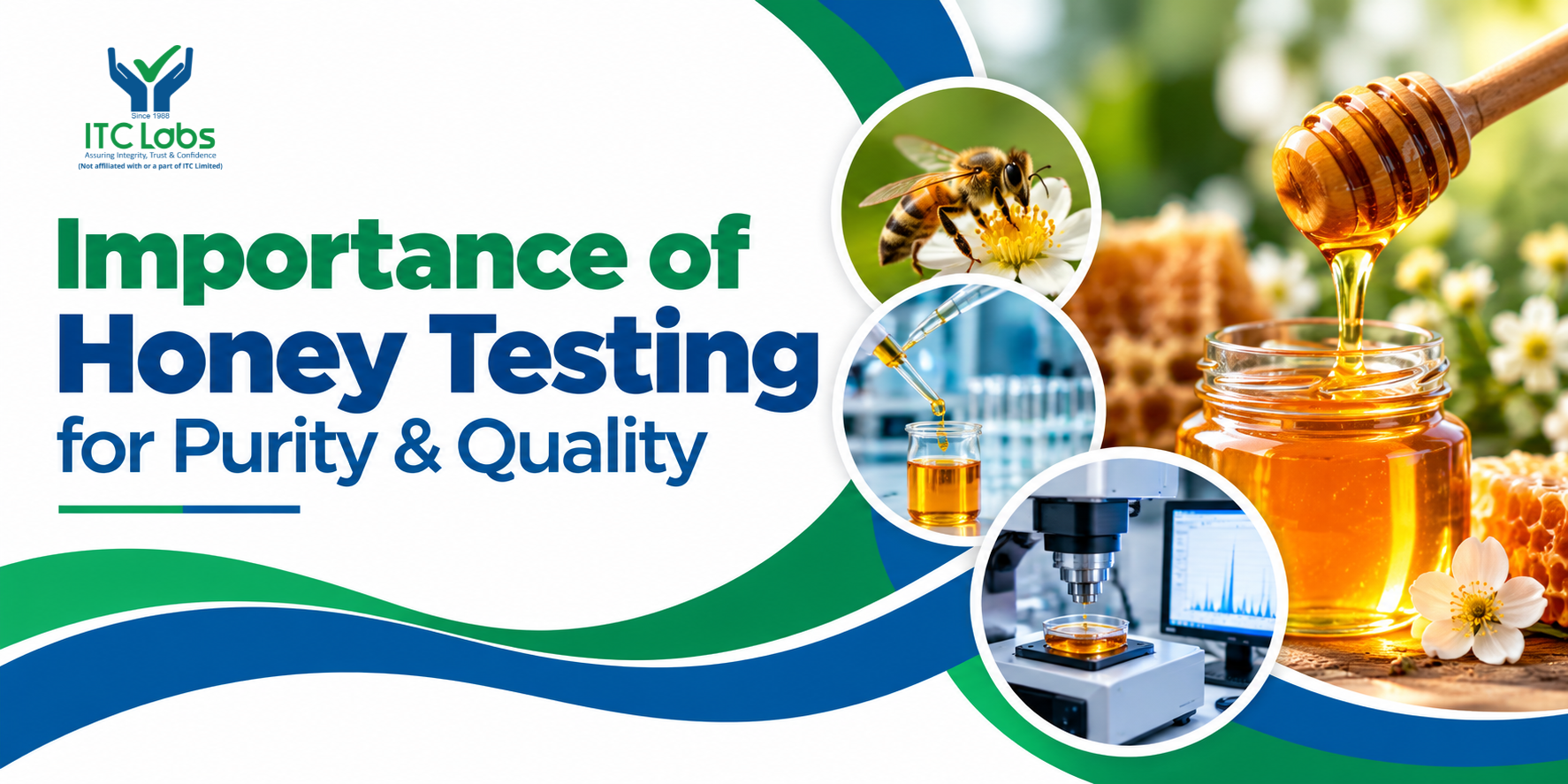
Honey is one of the most popular natural sweeteners, valued for its distinctive taste, aroma, and versatility. It is widely used in households, food manufacturing, bakery products, beverages, and health-oriented food products. With growing consumer interest in natural foods, the demand for pure and high-quality honey continues to create opportunities for honey producers, processors, and exporters.
However, ensuring honey purity and quality requires more than examining its colour, texture, or taste. Adulteration, improper handling, excessive moisture, and other quality issues can affect the authenticity, stability, and marketability of honey.
Honey testing plays an important role in evaluating purity, detecting potential adulteration, assessing quality parameters, and supporting compliance with applicable food safety standards. For manufacturers, suppliers, and food businesses, laboratory analysis provides valuable information to support quality control and consumer confidence.
In this article, we explore why honey testing is important, the key parameters laboratories analyse, common adulteration concerns, and how ITC Labs can support food testing requirements.
What Is Honey Testing?
Honey testing is the laboratory analysis of honey to evaluate its composition, quality, authenticity, and compliance with relevant specifications.
Depending on the product and testing requirements, analysis may include moisture content, sugar composition, acidity, electrical conductivity, hydroxymethylfurfural (HMF), diastase activity, and other relevant parameters.
Additional specialised testing may be required to investigate suspected sugar syrup adulteration, pesticide residues, or other contaminants.
Honey testing is useful for:
- Honey producers and beekeepers
- Honey processing and packaging companies
- Food manufacturers using honey as an ingredient
- Importers and exporters
- Retailers and distributors
- Businesses seeking to verify product quality and regulatory compliance
The appropriate testing plan depends on the honey type, its origin, processing history, intended market, and applicable food standards.
Why Is Honey Testing Important?
1. Verifying Honey Purity and Authenticity
One of the primary purposes of honey testing is to assess whether a product’s composition is consistent with its declared identity and applicable requirements.
Honey may be adulterated through the addition of certain sugar syrups or other substances. Such practices can affect its authenticity and may result in non-compliance with food standards.
Laboratory analysis can help investigate suspected adulteration by examining sugar profiles and other characteristics associated with honey composition.
Depending on the suspected adulterant, specialised techniques such as stable carbon isotope ratio analysis or advanced sugar profiling may be appropriate.
It is important to understand that no single test can detect every possible form of honey adulteration. A combination of suitable analytical methods may be needed to investigate specific concerns.
Why it matters: Authenticity testing helps businesses evaluate product integrity, verify supplier claims, and support consumer confidence.
2. Checking Moisture Content
Moisture content is an important quality parameter because it influences honey’s stability and susceptibility to fermentation.
Honey with excessive moisture may be more prone to fermentation under favourable conditions, potentially affecting its taste, aroma, and overall quality.
Laboratories can determine moisture content using suitable analytical methods, including refractometric measurement.
Testing helps producers and processors assess whether their honey meets the applicable moisture requirements and identify batches that may need further evaluation.
Why it matters: Monitoring moisture content helps businesses maintain consistent quality and make informed decisions about processing and storage.
3. Evaluating Sugar Composition
Honey naturally contains different sugars, primarily fructose and glucose, along with smaller quantities of other sugars.
Evaluating the sugar composition helps laboratories assess selected characteristics of honey and investigate possible inconsistencies with expected composition.
Testing may include analysis of fructose, glucose, sucrose, and other sugars, depending on the applicable standard and the reason for testing.
Chromatographic methods, such as high-performance liquid chromatography (HPLC), may be used for suitable sugar analyses.
Sugar composition results must be interpreted alongside other parameters because natural variation can occur depending on floral source, geographical origin, and processing conditions.
Why it matters: Sugar analysis supports quality evaluation and can contribute to a broader investigation of honey authenticity.
4. Measuring Hydroxymethylfurfural (HMF)
Hydroxymethylfurfural, commonly known as HMF, is a compound that can form in honey during heating and storage. Its concentration may be influenced by temperature, storage duration, and the natural characteristics of the honey.
Elevated HMF levels may indicate excessive heating, prolonged storage under unsuitable conditions, or other factors that require investigation.
Laboratories can determine HMF using suitable analytical methods, including spectrophotometric or chromatographic techniques, as applicable.
The results can be compared with the relevant requirements for the product and market.
Why it matters: HMF testing helps businesses evaluate certain aspects of honey quality and assess the effects of processing and storage.
5. Assessing Diastase Activity
Diastase is a naturally occurring enzyme found in honey. Its activity can be affected by heating and storage.
Diastase activity is one of the parameters used to assess honey quality under relevant standards. However, enzyme activity can also vary naturally between honey types, so results must be interpreted in the context of the applicable specifications.
Suitable laboratory methods can measure diastase activity and help determine whether the sample meets the relevant requirements.
Why it matters: Diastase testing can provide useful information about honey quality and its processing or storage history when considered alongside other test results.
6. Checking Acidity and Electrical Conductivity
Acidity and electrical conductivity are additional parameters used to characterise honey.
Acidity can provide information about the chemical characteristics of the sample, while electrical conductivity is associated with its mineral and other dissolved constituents.
These parameters can vary with floral source and honey type. They should therefore be assessed against the appropriate specifications rather than a single universal value.
Laboratory analysis of these characteristics can contribute to product quality evaluation and help identify results that require further investigation.
Why it matters: Testing acidity and electrical conductivity supports a more complete assessment of honey composition and quality.
7. Supporting Contaminant Monitoring
Honey may require testing for certain contaminants depending on its source, production practices, intended market, and risk assessment.
Potential testing requirements may include pesticide residues, heavy metals, or other substances regulated under applicable food safety standards.
Not every honey sample requires every possible contaminant test. A suitable testing programme should be designed according to the relevant risks, regulatory requirements, and customer specifications.
Why it matters: Appropriate contaminant testing helps food businesses evaluate selected safety concerns and support regulatory compliance.
Looking for Reliable Honey Testing Services?
Ensure honey purity, authenticity, and quality with ITC Labs’ food testing services. Get reliable insights into honey adulteration, moisture content, sugar composition, and other essential quality parameters.
Common Honey Adulteration Concerns
Honey adulteration can involve the addition of substances that alter its natural composition or misrepresent its identity.
Common concerns include:
- Addition of sugar syrups: Certain syrups may be added to honey to increase volume or change its composition.
- Undeclared sweetening ingredients: Ingredients that are not permitted or properly declared may affect authenticity and compliance.
- Excessive heating: Although not adulteration itself, unsuitable heating can affect certain honey quality parameters.
- Improper storage: Poor storage conditions can contribute to quality deterioration and changes in selected analytical characteristics.
Detecting adulteration can be challenging because some added syrups are designed to resemble the natural sugar composition of honey.
For this reason, reliable assessment may require multiple analytical techniques selected according to the suspected adulterant. Basic appearance, taste, viscosity, or home testing methods cannot conclusively establish that honey is pure.
Key Parameters Tested in Honey Analysis
The following table summarises commonly assessed honey parameters and their purpose.
| Test parameter | Why it matters |
| Moisture content | Helps evaluate stability and potential fermentation risk. |
| Sugar composition | Supports compositional assessment and investigations into authenticity. |
| HMF | Helps assess quality changes associated with heating and storage. |
| Diastase activity | Provides information about enzyme activity and selected quality characteristics. |
| Acidity | Helps characterise the chemical properties of honey. |
| Electrical conductivity | Supports the assessment and characterisation of honey composition. |
| Adulteration screening | Helps investigate suspected addition of sugar syrups or other substances. |
| Contaminant analysis | Evaluates selected contaminants where required by the product’s risk profile or applicable standards. |
The precise test requirements depend on the honey type and the standards applicable to its intended market. Test reports should be interpreted using the relevant limits, analytical methods, and sample information.
Who Should Get Honey Tested?
Honey testing is valuable for different businesses throughout the supply chain.
Honey Producers and Beekeepers
Testing helps producers assess product quality, monitor relevant parameters, and obtain analytical information about their honey.
Honey Processing and Packaging Companies
Processors can use laboratory results to support incoming material checks, batch consistency, quality assurance, and product release decisions.
Food Manufacturers
Businesses that use honey in bakery products, beverages, confectionery, sauces, and other foods may require testing to verify ingredient specifications and supplier quality.
Honey Exporters and Importers
International trade may involve additional product specifications, documentation, and regulatory requirements. Testing can help businesses evaluate whether honey meets the requirements applicable to the destination market.
Retailers and Distributors
Businesses purchasing honey from suppliers can use suitable testing programmes as part of their supplier verification and quality management procedures.
How to Choose the Right Honey Testing Laboratory
Choosing an appropriate food testing laboratory is an important step towards obtaining reliable analytical results.
Before selecting a laboratory, consider the following factors:
- Accreditation and scope: Check the laboratory’s current accreditation status and confirm whether the required test parameters fall within its accredited scope.
- Relevant analytical capabilities: Ensure the laboratory can perform the specific honey tests required for your product.
- Suitable test methods: Ask whether the methods are appropriate for the suspected adulterant, quality parameter, or regulatory purpose.
- Regulatory requirements: Confirm that the selected tests align with the relevant food standards and destination-market requirements.
- Clear reporting: Ensure the test report identifies the parameters analysed, methods used, results, and applicable interpretation where provided.
- Additional testing services: Consider whether the laboratory can support other food testing requirements, such as contaminant analysis, shelf-life testing, and nutritional analysis.
A suitable testing partner can help businesses identify relevant analytical requirements and make more informed decisions about product quality and compliance.
Why Choose ITC Labs for Honey and Food Testing?
ITC Labs provides food testing services intended to support product quality evaluation, food safety management, and regulatory compliance across a range of food categories.
Based on the information provided by ITC Labs, its testing services cover products such as dairy, bakery goods, oils and fats, spices, and nutraceuticals.
Its stated capabilities include:
- Food quality analysis: Supports the evaluation of relevant quality parameters.
- Contaminant detection: Helps investigate selected contaminants according to the product and testing requirements.
- Shelf-life testing: Supports the assessment of product quality over defined storage periods.
- Allergen analysis: Helps businesses address relevant allergen testing and management requirements.
- Nutritional analysis: Supports nutritional assessment and labelling requirements.
For honey producers, processors, exporters, and food manufacturers, the appropriate testing plan should be confirmed according to the required parameters and ITC Labs’ available analytical capabilities.
ITC Labs has also provided information about its recognition and accreditation by bodies including NABL, FSSAI, and APEDA. Businesses should verify the current accreditation status, relevant scope, and availability of the specific honey tests they require before placing a testing request.
By choosing a suitable laboratory and establishing an appropriate testing programme, businesses can strengthen their quality assurance processes and support informed decisions about honey authenticity and quality.
Conclusion: Ensure Honey Purity and Quality with ITC Labs
Honey testing is an important part of maintaining product quality, investigating potential adulteration, and supporting food safety and regulatory compliance. Parameters such as moisture content, sugar composition, HMF, diastase activity, acidity, and electrical conductivity provide useful information about honey when interpreted against the appropriate standards.
For honey producers, processors, exporters, and food manufacturers, regular and risk-based testing can support supplier verification, batch consistency, and greater confidence in product quality.
Looking for food testing services for honey or other food products? Consider ITC Labs for your food testing requirements. With services covering food quality assessment, contaminant detection, shelf-life testing, allergen analysis, and nutritional labelling support, ITC Labs can help you discuss the appropriate testing options for your business.
Make laboratory testing part of your quality assurance process and take informed steps towards maintaining honey purity, consistency, and consumer confidence.
Frequently Asked Questions (FAQs)
1. Why is honey testing important?
Honey testing helps evaluate purity, composition, and selected quality and safety parameters. It can also help investigate suspected adulteration and support compliance with applicable food standards.
2. Which tests are commonly performed on honey?
Commonly assessed parameters include moisture content, sugar composition, HMF, diastase activity, acidity, and electrical conductivity. Additional testing may be required for suspected sugar syrup adulteration or selected contaminants.
3. How do laboratories detect adulteration in honey?
Depending on the suspected adulterant, laboratories may use sugar profiling, stable carbon isotope ratio analysis, and other specialised analytical techniques. Multiple methods may be necessary because no single test detects every possible adulterant.
4. Can pure honey be identified through a home test?
Home tests based on water solubility, viscosity, or appearance cannot reliably establish honey purity. Laboratory analysis using suitable methods is more appropriate when dependable results are needed for quality assurance or regulatory purposes.
5. Where can I get honey tested in a food testing laboratory?
You can contact a suitable food testing laboratory, such as ITC Labs, to discuss your honey testing requirements. Before submitting a sample, confirm the available tests, sample handling instructions, expected turnaround time, and relevant accreditation scope.